The Fed Raised Rates. Where Does That Leave Gold — and You?
Key Takeaways
- The Fed lifted its benchmark rate by 0.25% to 3.75%–4.00%1 — its first rate increase since July 2023.2
- Officials voted 12–0 to hike,1 and 16 of 18 policymakers projected at least one more increase before year-end.3
- Donald Trump demanded rates of “1% or less,” clashing directly with Fed Chair Kevin Warsh.3
- Cash yields are likely to see a modest bump, but existing bond funds and growth stocks face downward pressure.
- While a Fed rate hike aims to curb inflation, physical gold and silver historically have attracted safe-haven demand.
On Wednesday, September 16, the Federal Reserve did something it hasn’t done since July 2023: it raised interest rates.
By a unanimous 12–0 vote, the Fed bumped its benchmark rate up by a quarter percentage point to a range of 3.75%–4.00%. The Federal Open Market Committee (FOMC) said inflation remained elevated and that the hike would support a timelier return to its 2% goal.1 Officials had held rates steady at 3.50%–3.75% since late 2025.2
Think of the Federal Reserve as the thermostat for the entire US economy. When everyday costs run too hot, the Fed turns the rate dial up. A higher interest rate makes borrowing more expensive for everyone, so raising rates is designed to slow down spending and cool things off.
According to the Fed’s newly released projections, 16 of 18 policymakers expect at least one additional quarter-point increase before year-end.3

The Fed went 14 months without changing its rate. Then on September 16, 2026, it increased the rate for the first time since July 2023.
The Washington Showdown: Warsh vs. Trump
This unexpected rate hike didn’t just surprise Wall Street; it triggered an immediate clash between the White House and the Federal Reserve.
Earlier this year, President Trump nominated Kevin Warsh to lead the Federal Reserve and has repeatedly pressed for much lower interest rates.3
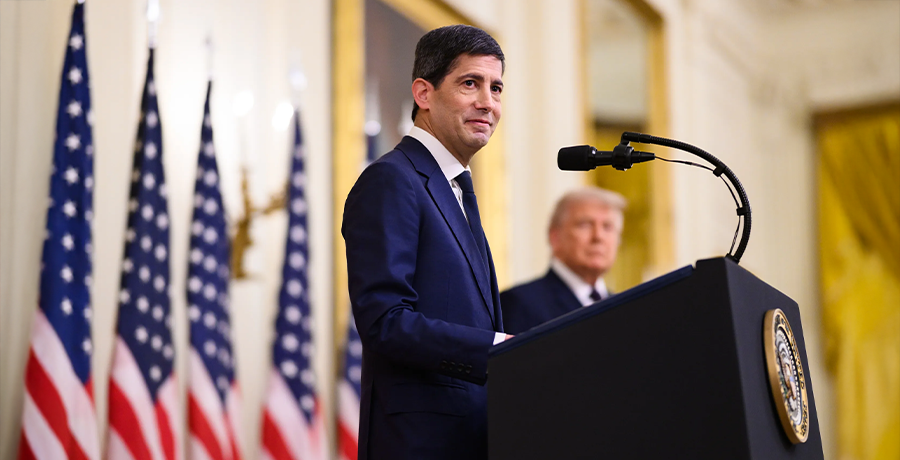
Warsh and the Fed board moved in the opposite direction. At last Wednesday’s post-meeting press conference, Warsh defended the decision:
“The plain fact is that inflation is too high and has been for too long.”3
—Kevin Warsh, Federal Reserve Chair, FOMC Press Briefing
Within two hours of the announcement, Trump posted a sharp reply on Truth Social:
“Interest rates in the United States should be 1%, or less, because we are the Best Credit in the World — BY FAR.”3
—President Donald J. Trump, on Truth Social as Reported by Reuters
And then, driving his message home in all caps, he demanded:
“LOWER THE INTEREST RATES FOR THE UNITED STATES OF AMERICA, AND FAST!”3
—President Donald J. Trump, on Truth Social as Reported by Reuters
When asked about the President at his press conference, Warsh gave up nothing:
“I don’t have anything for you on discussions with the president.”3
—Kevin Warsh, FOMC Press Briefing
The political tug-of-war is set. While politicians and the Fed debate policy, the practical question for everyday savers hits much closer to home: what does this Fed rate hike actually do to your money today?

The 4 Ways This Rate Hike Touches Your Retirement
1. Your Cash Earns a Modest Bump — With an Inflation Catch
If your cash sits in a high-yield savings account or a new Certificate of Deposit (CD), you will likely see a slight boost in the interest you earn.
But it’s important for retirees to check their real buying power. If grocery prices, utility bills, and insurance premiums are climbing faster than the modest yield your bank pays, your cash is still quietly losing purchasing power every single month.
2. Older Bond Funds Drop on Your Paper Statements
Many 401(k) and IRA portfolios rely heavily on bond funds for a conservative balance. When interest rates climb, the market value of existing bonds typically falls.
If you own a bond paying 3.0% and the government starts issuing new bonds paying 4.0%, investors generally will not pay full price for your older, lower-yielding bond. Assuming the issuer does not default, holding an individual bond to maturity generally means receiving its face value at maturity, while bond funds that contain a variety of assets reflect market-price changes on your paper statement.
3. Variable Debt Squeezes Fixed Incomes
Banks quickly adjust their prime lending rates following a Fed announcement. So, if you carry a balance on a credit card, hold an adjustable-rate mortgage, or rely on a home equity line of credit (HELOC), the cost of servicing that debt goes up after a Fed rate hike.
Carrying variable balances in a rising-rate climate directly may eat away at fixed retirement cash flow.
4. Growth Stocks Face Fresh Pressure
Broad stock market indexes have spent years being powered by high-growth technology companies. Those high-growth businesses are generally more sensitive to borrowing costs as they expand.
When borrowing costs increase, profit margins tighten, and high-flying stocks can logically experience market pullbacks. For this reason, savers who hold broad index funds may face sudden equity turbulence. If a saver is nearing retirement, this turbulence may come at a bad time, when they need their portfolio to support living expenses.
The Sleeper Asset: Why Uncertainty Points to Gold
Higher interest rates give savers a chance to earn more on their cash-based holdings. So, savers may pull money away from physical assets such as gold and silver which don’t pay interest or dividends. That can put downward pressure on precious metals prices.
That helps explain Wednesday’s gold price reaction: after the Fed rate hike, gold fell to a near six-week low.4 But that pause was short lived.
By Thursday, investors were reassessing the move as oil prices eased, and the US dollar softened. When Treasury yields slipped and oil prices eased, Reuters reported gold jumping 2.3% to $4,360.36 an ounce at 1:45 p.m. Eastern.4 On Friday afternoon, spot gold was up another 1.2% to $4,390.11.5
That quick rebound builds on momentum from earlier this summer. In August 2026 alone, gold gained 13%,6 while silver climbed close to 16%.7
This broader demand picture also includes central banks. The World Gold Council reports that central banks accumulated an average of about 1,000 tonnes of gold a year over the past four years, roughly double the average over the preceding decade.8
Its 2026 survey says central bankers cited gold’s performance during times of crisis, portfolio diversification, inflation hedging, and geopolitical-risk hedging among key reasons for holding or increasing gold.8
For retirement savers, it isn’t about moving every dollar into metal — it’s about gaining a prudent balance. While no asset is guaranteed to rise in value, physical gold and silver have historically been chosen by many investors as a tangible counterweight when paper-based assets experience volatility.
Take the Next Step: Request Your Free Info Kit
One hike is rarely the whole story.
The Fed’s own projections show that 16 out of 18 officials expect at least one more rate increase before the end of 2026.3
So, there’s a choice in front of you. Sit still. Or look at where the pressure is pointing and decide what belongs in your retirement mix.
If this week’s news has you wondering where physical gold and silver could fit your retirement plan, we created our free 2026 Gold & Silver IRA Info Kit to help you explore your options.
Inside, four focused guides explain why savers consider precious metals, how gold IRAs work, what to compare between companies, and what makes Augusta different.

Kindra Foster is a senior communications lead at Augusta Precious Metals, where she develops educational resources focused on retirement, gold IRAs and diversification. With nearly two decades of experience in financial and retirement communications, Kindra served as a senior writer for Mutual of Omaha’s insurance and investment divisions and for a regional assisted living management company. At Augusta, Kindra works closely with financial experts to create retirement education materials that are accurate, balanced, and compliant.
References
- Board of Governors of the Federal Reserve System. “Federal Reserve issues FOMC statement”. September 16, 2026.
- Board of Governors of the Federal Reserve System. “Open Market Operations”. updated September 16, 2026.
- Reuters. “Trump lashes out at Fed after Warsh backs rate hike”. September 16, 2026.
- Reuters. “Gold gains over 2% on weaker dollar, easing oil prices”. September 17, 2026.
- Reuters. “Gold rises to one-week high, heads for weekly gain on easing oil prices”. September 18, 2026.
- World Gold Council. “Gold Market Commentary: Paved with good interventions”. September 9, 2026.
- The Perth Mint. “Gold and Silver prices surge in August amid renewed market momentum”. September 2026.
- World Gold Council. “Central Bank Gold Reserves Survey 2026”. June 16, 2026.