5 “Facts” Everyone Believed — Until They Broke. Is Your Retirement Next?

Key Takeaways
- Widely accepted beliefs can change when new evidence emerges.
- Traditional diversification has limitations, especially when stocks and bonds fall together.
- Physical gold and silver may offer additional diversification for retirement savers.
Take a little trip back to the 1940s.
You’re flipping through a magazine when something catches your eye.
A cigarette advertisement featuring a doctor.
Sounds crazy today, doesn’t it?
One famous campaign even claimed, “More doctors smoke Camels than any other cigarette.”1
That really happened.
And cigarette advertisements were only one example of how trusted voices and repeated messages shaped what people believed.
Remember when doctors blamed stomach ulcers on stress and spicy foods? Researchers eventually discovered that bacteria and certain medications cause most ulcers.3
Or when parents were encouraged to put babies to sleep on their stomachs? Research eventually showed that sleeping on their backs significantly reduces the risk of sudden infant death syndrome (SIDS).4
Millions of people followed advice like this because it came from sources they trusted.
Then new evidence changed what we understood.
What are we so certain about today that we might look at differently 10 years from now?
And could some of those assumptions be influencing how you’ve invested your retirement savings?
5 Familiar Beliefs That Didn’t Hold Up
- Doctors once helped sell cigarettes.
Hard to imagine today, but tobacco companies once featured doctors in their advertisements.
One famous campaign even claimed, “More doctors smoke Camels than any other cigarette.”1
The message was reassuring. After all, if doctors smoked them, how harmful could they be?
Then came decades of research connecting smoking to serious diseases. In 1964, the U.S. Surgeon General released a landmark report establishing major health risks, including lung cancer.2
- Stress and spicy foods were blamed for stomach ulcers.
For years, people with stomach ulcers were often told to reduce stress and avoid spicy foods.
Then researchers discovered that a bacterium called H. pylori causes many ulcers. Certain pain medications, including aspirin and ibuprofen, are another major cause.3
That discovery transformed ulcer treatment. Many patients could now be treated with antibiotics targeting the underlying infection.
- Parents were once encouraged to put babies to sleep on their stomachs.
Many parents and grandparents may remember this one.
Stomach sleeping was commonly recommended for infants until research revealed that babies sleeping on their backs had a significantly lower risk of sudden infant death syndrome (SIDS).
The American Academy of Pediatrics updated its recommendations in the 1990s, and the Back to Sleep campaign helped spread the safer guidance nationwide.4
- Parents were told to delay giving young children peanuts.
In 2000, the American Academy of Pediatrics recommended that children at high risk of food allergies avoid peanuts until age three.
Then a major clinical trial found something surprising: Introducing peanut-containing foods during infancy reduced the risk of developing peanut allergy by 81% among the high-risk infants studied.6
Today, carefully managed early introduction is recommended, with medical guidance for certain higher-risk infants.
- Margarine was promoted as the healthier alternative to butter.
Remember when butter was on everyone’s nutritional blacklist?
Margarine became a popular substitute because it generally contained less saturated fat.
Then researchers discovered the health risks associated with industrial trans fats found in many older stick margarines.
Today, we know the type of fat matters. Many modern soft margarines are formulated with healthier unsaturated fats and without industrial trans fats.8
“The older stick margarines turned out to be clearly worse for you than butter.” 7
— Harvard Health Publishing, January 2018.
So, What Does Any of This Have to Do With Your Retirement?
Quite a bit, actually.
We hear something from an expert. We read it in the news. We hear it again from friends or family.
Before long, it becomes something we’ve always believed.
And that can happen with money, too.
Think about the retirement advice you’ve heard over the years. How much should you hold in stocks and bonds? What makes an investment safe? How do you protect your purchasing power?
Those are big questions when you’ve spent 30 or 40 years building a nest egg.
And as you approach retirement, even a reasonable financial assumption deserves an occasional second look.
Consider three of them.
3 Retirement Assumptions Worth Revisiting
Assumption #1: “If I own stocks and bonds, my retirement savings are well protected.”
Most retirement savers have heard the same advice for decades: Diversify your investments by holding both stocks and bonds.
And there’s good reason for it.
But are you really as diversified as you think?
Consider what happened in 2022.
According to Morningstar, its broad U.S. stock market index fell 19.4%, while its core bond index dropped 12.9%.
Even a traditional 60/40 portfolio benchmark — 60% stocks and 40% bonds — lost 15.3%.9
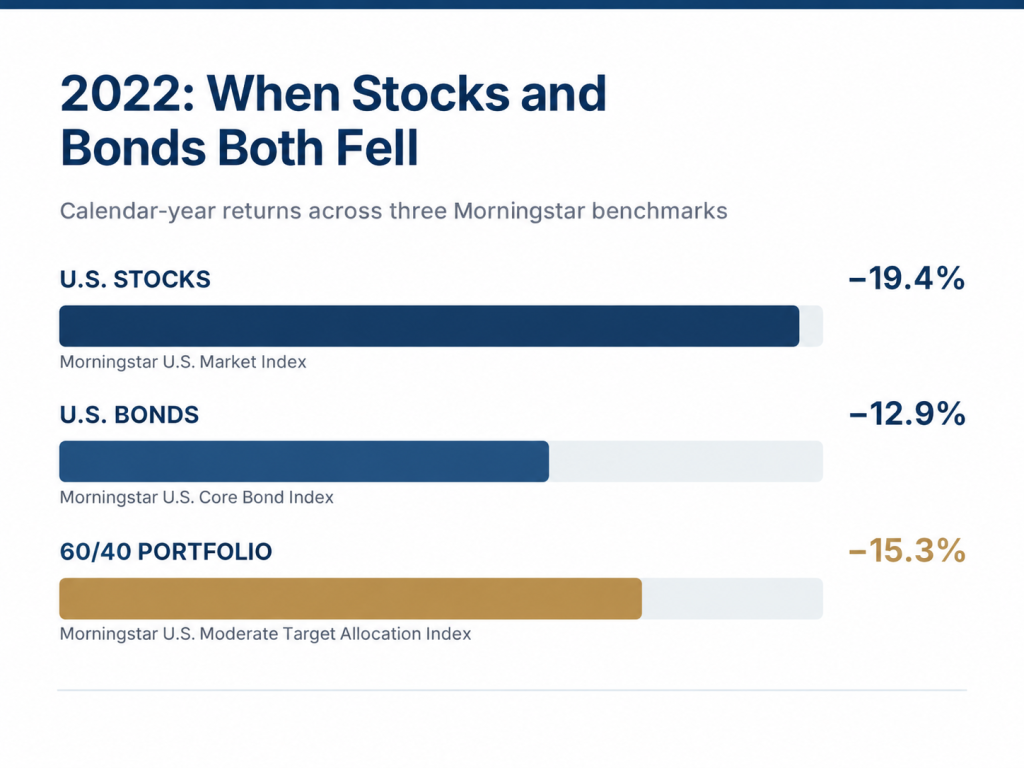
In 2022, stocks and bonds declined together, challenging an assumption about traditional portfolio diversification. Source: Morningstar, 2022 calendar-year returns.
Imagine watching both sides of your retirement portfolio decline just as you’re preparing to retire.
Traditional diversification remains important. But 2022 exposed a vulnerability many savers hadn’t fully considered: Stocks and bonds can struggle at the same time.
It also showed why retirement portfolio diversification deserves a closer look, including whether assets with different market drivers might play a role.
If your stocks and bonds fall together again, what else is in your retirement portfolio?
That’s a question worth answering before the next major downturn.
Assumption #2: “If my money is sitting safely in cash, I can’t lose.”
There’s something comforting about seeing a steady balance in your savings account.
The dollar amount is right there. You know what you have available.
And for emergency savings, near-term spending needs, and liquidity, cash can be extremely valuable.
But consider what happens when everyday expenses rise faster than the interest your cash earns.
Your account balance may increase while its purchasing power falls behind.
The Securities and Exchange Commission identifies inflation as a principal concern for investors holding cash equivalents because rising prices can erode the value of investment returns over time.10
Think about your grocery bill, homeowners insurance, utilities, or medical expenses.
The dollars you saved years ago may cover fewer of those expenses today.
And with retirement potentially lasting 20 or 30 years, purchasing power becomes an important consideration.
How much will the money you’ve saved actually buy when you need it?
Assumption #3: “Gold doesn’t pay interest, so why would I want it in my retirement portfolio?”
You’ve probably heard this argument.
And the first part is correct.
Physical gold doesn’t pay interest or dividends.
For retirement savers who need regular income, that’s a meaningful consideration.
But income is only one of the jobs an investment can perform.
Some assets are held for growth. Others provide income, liquidity, or diversification.
Gold has different demand drivers from traditional stocks and bonds, including purchases by investors, jewelry buyers, and central banks.
In its 2026 research, the World Gold Council discusses gold’s potential to improve portfolio diversification because its performance can differ from that of stocks and bonds under certain market conditions.11
That distinction matters when evaluating retirement portfolio diversification.
Gold has its own risks, of course. Its price can be volatile, it can experience extended periods of disappointing performance, and physical ownership involves transaction costs.
Silver also offers exposure to a physical precious metal, with its own market drivers, opportunities, and risks.
And if you’re considering physical gold or silver in a self-directed IRA, understanding the dealer’s buying and selling prices, custodian arrangements, storage requirements, and applicable fees is essential.12
So, here’s something to consider:
Does every investment in your retirement portfolio need to accomplish the same thing?
Or might your overall strategy benefit from assets that serve different purposes?
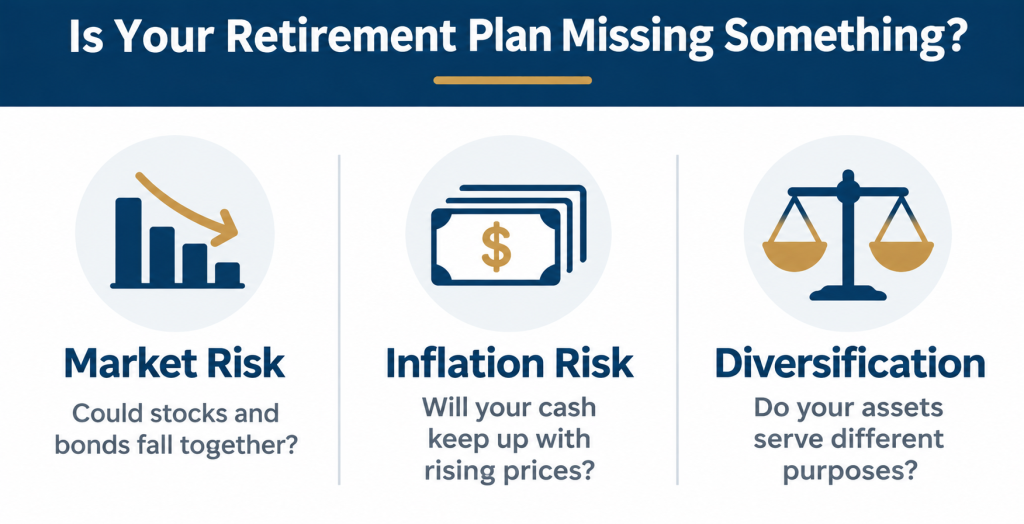
A retirement review should consider market losses, inflation, and the different roles investments may play.
The Retirement Lesson Hidden in These Five Stories
Here’s what all five examples have in common: People made decisions based on advice they trusted. And as new evidence emerged, that advice changed.
Our understanding of money evolves, too.
Interest rates change. Inflation changes. Markets behave in ways we don’t always expect.
And a retirement strategy you put together 20 years ago may deserve another look today.
Especially when retirement is getting closer and you have less time to recover from a major financial setback.
So, consider three questions:
- How would my savings respond if stocks and bonds fell together?
- How much of my retirement savings could be affected by years of rising living costs?
- Have I considered whether physical assets, including gold and silver, could help diversify my portfolio?
You may find that your current plan already addresses these risks. Or you may discover something worth exploring further.
Something doesn’t become true simply because we’ve heard it a thousand times.
And when it comes to your retirement, some assumptions are worth questioning before you discover their limitations the hard way.
Want to See Where Physical Gold and Silver Might Fit?
If you’ve been curious about diversifying a portion of your retirement savings with physical gold or silver, Augusta Precious Metals can help you understand the options.
Our free, one-on-one educational web conference gives qualified retirement savers the opportunity to speak with a salaried, no commission educator — not a salesperson.
You’ll learn how a Gold IRA works, what costs and risks to consider, and what to evaluate before making a decision.

Our mission is to educate and empower investors across America to protect their retirement and gain peace of mind for the future.
References
- American Journal of Public Health. The Doctors’ Choice Is America’s Choice: The Physician in US Cigarette Advertisements, 1930–1953. Accessed November 12, 2026.
- Centers for Disease Control and Prevention. A History of the Surgeon General’s on Smoking and Health. Accessed November 12, 2026Reports.
- National Institute of Diabetes and Digestive and Kidney Diseases. Symptoms & Causes of Peptic Ulcers. Accessed November 12, 2026.
- National Institute of Child Health and Human Development. Safe to Sleep: Campaign History. Accessed November 12, 2026.
- Allergy Asthma Proceedings. The National Institutes of Allergy and Infectious Diseases Sponsored Guidelines on Preventing Peanut Allergy: A New Paradigm in Food Allergy Prevention. Allergy & Asthma Proceedings. Accessed November 12, 2026.
- National Institutes of Health. Providing Lasting Protection From Peanut Allergy.
Accessed November 12, 2026. - Harvard Health Publishing. Butter vs. Margarine. Accessed November 12, 2026.
- U.S. Food and Drug Administration. Trans Fat. Accessed November 12, 2026.
- Morningstar. So, Just How Bad Was 2022 for US Investors? Accessed November 12, 2026.
- U.S. Securities and Exchange Commission, Investor.gov. Beginners’ Guide to Asset Allocation, Diversification, and Rebalancing. Accessed November 12, 2026.
- World Gold Council. Gold as a Strategic Asset: 2026 Edition — Diversification. February 4, 2026.
- U.S. Securities and Exchange Commission, Investor.gov. Investor Alert: Self-Directed IRAs and the Risk of Fraud. Accessed November 12, 2026.