Gold at $5,200 in 2027? Who Really Decides?
Key Takeaways
- CIBC forecasts gold averaging $5,200 in 2027.
- A Reuters analyst survey projects $4,650.
- No single bank or government sets gold’s market price.
- Central banks, interest rates, and global trading move prices.
- The spot price isn’t necessarily what you’ll pay for physical gold.
A major Canadian bank sees gold averaging $5,200 an ounce in 2027.1
A Reuters survey of 30 analysts and traders sees something considerably lower: $4,650.2
That’s a $550 difference in forecasts for the same year.
And here’s the twist.
The bank predicting $5,200 — CIBC Capital Markets — previously expected gold to average $6,500 in 2027.
It just lowered that forecast by $1,300.1
These experts study the same global economy. They follow the same financial markets. They have access to enormous amounts of research.
So why are their predictions so different?
And here’s a question you might never have considered:
Who decides what an ounce of gold is worth?
To understand where gold might go in 2027, it helps to understand how its price is determined today.
The answer takes us from a London auction to Wall Street trading desks, central bank vaults, and a global market where billions of dollars change hands.
Who actually sets the price of gold?
You can check the price of gold almost anywhere.
Financial websites. Television news. A precious metals dealer’s website.
They’ll display a price per ounce, sometimes changing by the second.
But where does that number come from?
No single person, bank, or government sets the global market price of gold.
Prices emerge from buying and selling across interconnected markets around the world.
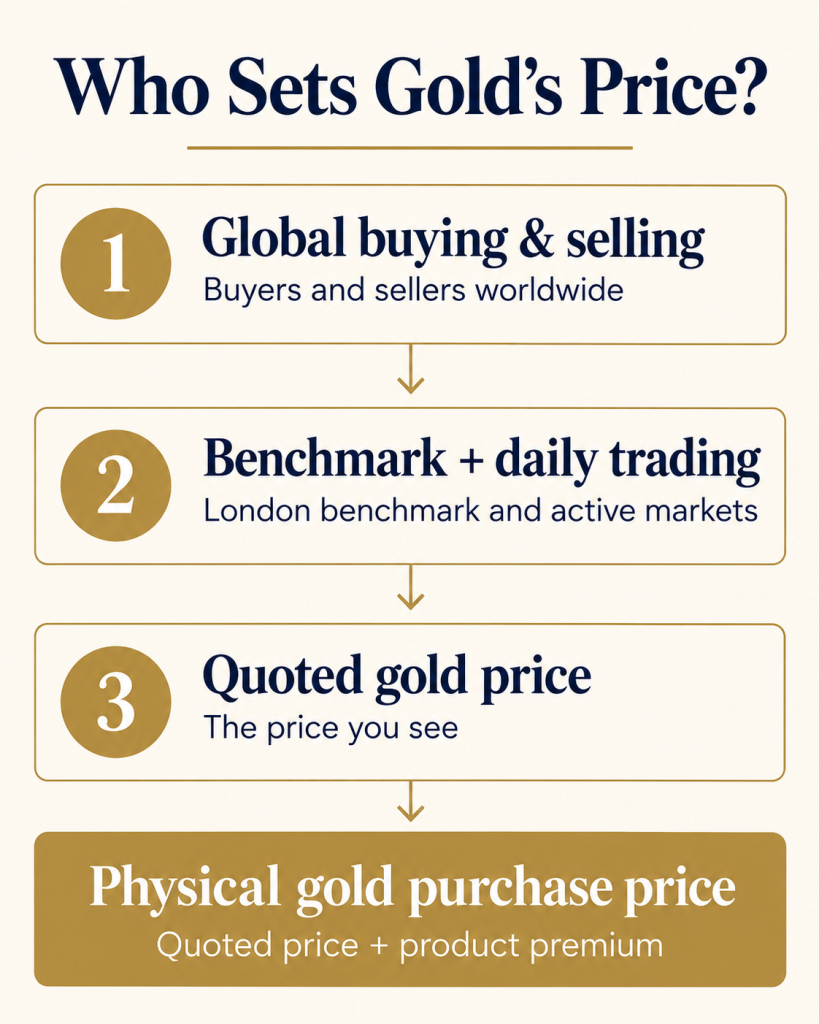
Gold’s price is shaped by global buying and selling, while physical gold prices also include product premiums. Sources: London Bullion Market Association; World Gold Council; The Royal Mint.8
And this market is enormous.
According to the World Gold Council, approximately $361 billion worth of gold traded per day, on average, in 2025. That figure includes trading in gold-related contracts, not simply physical coins and bars.3
Among the world’s most important gold trading centers are London, New York, and Shanghai.
Each helps shape the price investors see.
But one location has a particularly important role.
The London auction that helps establish gold’s price
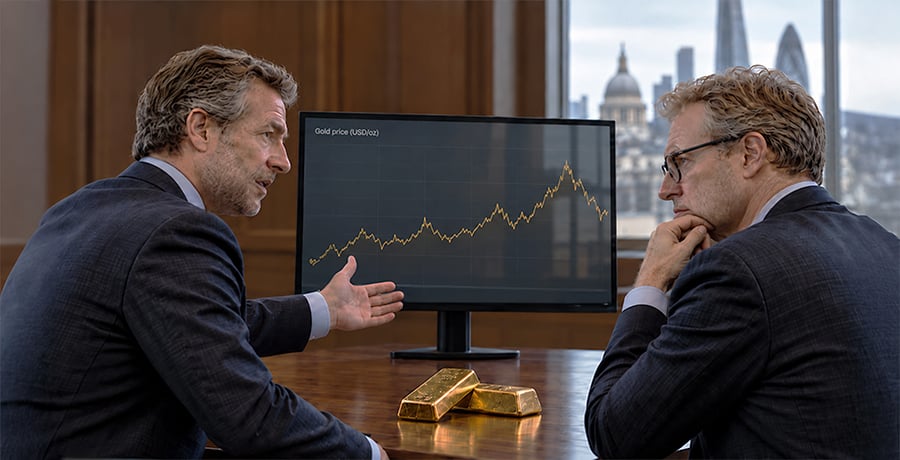
Twice each business day, at 10:30 a.m. and 3 p.m. London time, an electronic auction establishes a widely used international benchmark called the LBMA Gold Price.
“The LBMA Gold Price is set twice daily in auctions independently operated and administered by ICE Benchmark Administration Limited (IBA)…”4
- The London Bullion Market Association
Here’s how it works in simple terms.
Participating institutions submit buy and sell orders. The auction adjusts its proposed price through successive rounds until buying and selling interest balance within the auction’s rules.
The resulting benchmark is used throughout the global gold industry for pricing, valuation, and transactions.
But here’s something important:
Gold doesn’t stop changing price when the London auction ends.
Trading continues across global markets, including the COMEX gold futures market in New York and major markets in Asia.
Futures contracts allow participants to trade agreements based on gold prices for future settlement or delivery. That activity also helps influence prices today.
Together, these interconnected markets help explain why gold prices can respond so quickly to economic announcements, changing expectations, and major world events.
And why predicting gold’s future price is so difficult.
Five forces that move the price of gold
The World Gold Council identifies economic expansion, risk and uncertainty, opportunity cost, and market momentum as major drivers of gold’s performance.5
For investors, those forces can be understood through five things worth watching.
- Central banks: some of the world’s biggest gold holders
Central banks hold gold as part of their official reserves.
When they buy more, they can add substantial demand to the global market.
Their decisions may also reveal something about how governments view currency exposure, financial uncertainty, and the need to diversify their reserves.
According to the World Gold Council, central banks and other official institutions collectively held more than 38,000 tonnes of gold at the end of 2025.3
Their buying decisions matter. But even major central bank purchases don’t guarantee higher prices.
- Interest rates: gold has competition
Gold doesn’t pay interest.
So, when inflation-adjusted interest rates rise, interest-bearing investments may become more attractive to some investors.
When those rates fall, the opportunity cost of holding gold can diminish.
It’s one reason Federal Reserve decisions can influence gold prices, even though the Fed doesn’t directly set them.
- The U.S. Dollar: one currency, worldwide consequences
Gold is commonly priced internationally in U.S. dollars.
When the dollar strengthens, gold can become more expensive for buyers using other currencies, potentially weighing on demand.
A weaker dollar can have the opposite effect.
But the relationship isn’t automatic. Other forces can outweigh currency movements.
- Large market participants: prices can move fast
Large financial institutions and traders can buy or sell enormous quantities of gold in response to economic news, changing interest-rate expectations, or shifts in market sentiment.
When enough participants sell at once, prices can fall quickly — even while central banks and other buyers continue accumulating physical gold.
It’s one reason gold prices can move sharply in the short term, even when longer-term demand remains intact.
- Gold supply: new gold takes time to produce
Gold mining companies can’t instantly increase production when prices rise.
New mines can require years of exploration, permitting, financing, and development.
Recycling also contributes to supply, while demand for jewelry, technology, and physical investment products changes over time.
Together, these factors influence how much gold is available relative to how much buyers want.
The critical point? These five forces don’t move in lockstep.
One can support gold while another pushes its price lower.
And that brings us back to those conflicting 2027 forecasts.
Why do experts disagree on gold prices for 2027?
Consider the projections published in October 2026.
2027 Gold Price Forecasts
| Source | 2027 Forecast |
|---|---|
CIBC Capital Markets | $5,200/oz |
Reuters Analyst Survey | $4,650/oz |
Both figures represent projected 2027 annual average gold
prices, not year-end targets.
CIBC also forecast gold averaging $4,500 per ounce in the fourth quarter of 2026, before averaging $5,200 in 2027.1
Why the expected recovery?
CIBC’s analysts pointed to several forces that could support gold over the longer term:
- Continued central bank buying
- Government debt concerns
- Geopolitical uncertainty
- The potential for lower inflation-adjusted interest rates
But they also acknowledged the obstacles facing gold: elevated real interest rates and a stronger U.S. dollar.
Other forecasters weigh those same factors differently.
In its October 27 survey, Reuters reported that analysts expected higher Treasury yields and dollar strength to remain obstacles, even while central bank purchases and demand for physical gold could provide support.2
The disagreement comes down to assumptions about what happens next.
Will inflation stay elevated? Will the Fed continue raising interest rates or eventually reverse course? Will central banks maintain their appetite for gold? Could another global crisis change investor behavior?
Every forecast relies on answers to questions like these.
Change the assumptions, and the forecast can change dramatically.
CIBC’s own revision illustrates that. Its projected 2027 annual average fell from $6,500 to $5,200 — a 20% reduction in the forecast.1
That doesn’t mean gold’s actual price dropped 20% when the bank changed its estimate.
It means the bank reassessed the future.
And there’s a real-world example of just how unpredictable those competing forces can be.
Gold fell 8.5%. Yet CIBC still sees $5,200. How?
In September 2026, gold lost 8.5% of its value in a single month.6
Yet just weeks later, CIBC forecast that gold would average $5,200 an ounce in 2027.1
How can gold fall that sharply when major banks still expect higher prices ahead?
Because what pressures gold in the short term may be very different from what supports it over the long term.
In September, rising Treasury yields and a stronger U.S. dollar pressured gold prices. Selling by large market participants added to the decline.6
But zoom out, and a different picture appears.
During the first half of 2026, central banks purchased a net 345 tonnes of gold. Global demand for physical gold bars and coins reached 784 tonnes — one of the strongest first-half performances on record.7
Those purchases preceded September’s decline, but they help explain why longer-term demand remains part of the conversation.
Gold was facing short-term selling pressure even as substantial demand for physical ownership had been demonstrated earlier in the year.
That’s the part of gold pricing many investors overlook.
No single group of buyers controls the market. And strong physical demand doesn’t guarantee that prices will rise.
Gold’s price reflects competing forces, sometimes pulling in opposite directions.
That’s why respected forecasters can study the same gold market and still arrive at different conclusions about 2027.
What should retirement savers take from the $5,200 forecast?
For someone approaching retirement, a forecast like CIBC’s can raise two very different reactions.
If you already own gold, you may wonder how much further prices could go.
If you’re considering buying, you may wonder whether now is the wrong time.
Both are reasonable questions. But there’s a better one:
What role would gold play in your retirement plan?
Physical gold offers exposure to an asset with different characteristics from stocks, bonds, or cash. Some retirement savers consider it as part of a broader diversification strategy.
But gold can experience significant price declines. It generates no interest or dividends, and physical ownership involves costs that can affect the investment’s outcome.
A price forecast doesn’t account for your retirement timeline, your existing investments, or your tolerance for market volatility.
And there’s one additional distinction worth understanding…
The gold price on your screen isn’t necessarily what you’ll pay
The market price you see quoted is generally a spot reference for gold.
When purchasing a physical coin or bar, the price usually includes a premium above the underlying metal value.
That premium can reflect manufacturing, distribution, product demand, and dealer costs. Different dealers and products may carry different premiums.8
If you’re evaluating a physical purchase, you should also understand the dealer’s actual same-day buyback offer for those same products, along with any applicable account or storage fees. Those costs are important regardless of whether gold eventually reaches $5,200, exceeds it, or falls below today’s forecasts.
The price of gold is one part of your decision.
Understanding the full economics of ownership is another.
The most important number might not be $5,200
CIBC could be right about 2027.
The Reuters survey could prove closer to reality.
Or gold could move outside the range both are anticipating.
That’s the nature of a market influenced by investors, governments, interest rates, currencies, and events nobody can fully predict.
The next time you see a headline announcing a new gold price target, look beyond the number.
Ask what assumptions are behind it.
Ask what’s happening in the markets that establish gold’s price.
And if you’re considering physical gold for retirement, ask what ownership would really involve.
Knowing where experts think gold is headed is useful. But, understanding how the market works can help you evaluate those predictions for yourself.
Gold prices are changing. Get clear answers before you decide.
Wondering whether physical gold and silver may fit your retirement?
Augusta Precious Metals offers a free, one-on-one educational web conference where you can learn about precious metals, gold & silver IRAs, purchase costs, and questions to ask before buying.
You’ll meet with a salaried, no-commission educator — not a salesperson.
If you have $50,000 or more available for a qualifying precious metals purchase, it’s an opportunity to get informed before deciding what to do next.

Our mission is to educate and empower investors across America to protect their retirement and gain peace of mind for the future.
References
- Kitco News. CIBC Slashes Gold Price Forecasts but Sees Recovery to $5,200 in 2027. October 20, 2026.
- Reuters. Strong Dollar, High Yields Drag on Gold Outlook, but Central-Bank Demand Lends Support. October 27, 2026.
- World Gold Council. Gold Market Primer: Market Size and Structure. August 18, 2026.
- London Bullion Market Association. LBMA Precious Metal Prices. Benchmark auction and administration information.
- World Gold Council. Gold Mid-Year Outlook 2026: Point Break. July 1, 2026.
- World Gold Council. Gold Market Commentary: Go With the Flow. October 7, 2026.
- World Gold Council. Gold Demand Trends: Q2 2026. July 30, 2026.
- The Royal Mint. How Are Bullion Prices Set?. Explanation of spot pricing and physical-product premiums.
Precious metals prices can rise or fall, and forecasts are not guarantees of future performance. Physical precious metals involve costs and risks. This article is for general educational purposes and is not individualized financial advice.