Can Interest Rates and Gold Buying Rise Together?
Key Takeaways
- Higher Treasury yields can tell two different stories. They may reflect economic strength, growing uncertainty, or both.
- Trust matters. Concerns about government debt, inflation, and future purchasing power may influence both bond yields and gold buying.
- Physical gold demand remains significant. In Q2 2026, U.S. bar-and-coin demand rose 28% while global central bank purchases increased 62% year over year.6
You see it in the financial headlines: U.S. government bonds are paying more interest.
Sounds like good news, right?
After all, who wouldn’t want to earn more on their savings?
But here’s a question most people never think to ask: Why is the government paying more to borrow money?
A recent New York Times article, examined an often-overlooked part of the bond market that can help explain why investors demand higher returns.1
And one factor worth considering is something you can’t easily measure on an account statement.
Trust.
When investors become more concerned about America’s debt, inflation, or financial future, they may demand more compensation for lending money to the government.
And that raises an even more interesting question.
Could some of the same concerns pushing interest rates higher also encourage investors to buy physical gold?
If you’re retired or getting close, this connection is worth understanding. It could change how you look at the bonds in your portfolio, the purchasing power of your savings, and gold’s potential role in your retirement.
Why Are Treasury Yields Rising?
First, a quick explanation.
When you buy a U.S. Treasury bond, you’re lending money to the federal government. In return, the government promises to repay that money according to the bond’s terms, with interest.
The return investors can expect from a bond is called its yield.
And lately, Treasury yields have climbed sharply this year, despite pulling back this week.
But here’s where it gets interesting.
There are two very different reasons investors might demand higher yields:
The first is economic strength.
When the economy is growing, investors may expect inflation or interest rates to stay higher. That can push Treasury yields up, too.
In that scenario, higher yields can be a reflection of a resilient economy.
The second is growing uncertainty.
Investors may become concerned about how much the government is borrowing, whether inflation will remain elevated, or what their money will be worth years from now.
So, they may demand more compensation for lending their money over a long period.
Both forces can push yields higher, and both can happen at the same time.
Federal Reserve Governor Christopher Waller recently pointed to stronger economic growth as a leading reason for higher Treasury yields, while also discussing the possible effects of government debt and changing demand for Treasuries.2
Just Look at What Happened This Week
AI-related stocks stumbled. Worried investors turned to U.S. Treasury bonds.
That buying pushed bond prices higher and yields lower. In fact, the Financial Times reported on October 16 that Treasuries were heading for their strongest week since February.3
Here’s the twist: Investor fears can push Treasury yields in either direction.
Worried about stocks? Investors may buy Treasuries for safety, pushing yields down.
Worried about Washington’s debt? Investors may demand higher yields to hold long-term Treasuries, pushing yields up.
That’s why it’s important to understand what’s driving Treasury yields—not just whether they’re going up or down.
The Hidden Cost of Uncertainty
This is where a little-known financial term enters the picture.
It’s called the term premium.
The concept is simpler than it sounds.
Suppose you lend someone money for 10 years.
That’s a long commitment. Interest rates could change. Inflation could rise. A lot could happen before you get your money back.
You might want a little extra compensation for accepting that uncertainty.
Bond investors think about long-term commitments in a similar way.
The Federal Reserve Bank of New York defines the term premium as:
“the compensation that investors require for bearing the risk that interest rates may change over the life of the bond.” 4
In simpler terms, it’s part of the return investors demand for accepting the uncertainty of holding a longer-term bond.
And if concerns about inflation, government borrowing, or future interest rates increase, that premium may rise.
That means longer-term Treasury yields can climb even without another rate increase from the Federal Reserve.
One caution: The term premium is an estimate, and an increase doesn’t automatically mean investors are losing faith in the U.S. government.
Still, investor confidence can play a role in what lenders demand.
The less comfortable investors become about the long-term financial outlook, the more compensation they may want for committing their money.
And that brings us to something worth considering.
What if the money you get back doesn’t buy as much?
That’s where the connection to physical gold gets particularly interesting.
Why Could Higher Interest Rates Encourage Gold Buying?
Ordinarily, higher yields create more competition for gold.
Government bonds pay interest. Physical gold doesn’t.
So, when Treasury yields rise, bonds may look more attractive to investors seeking income.
But, what if investors are demanding higher returns because they’re increasingly concerned about debt, inflation, or the dollar’s future purchasing power?
Those same concerns could lead some investors to consider physical gold.
Think about the difference.
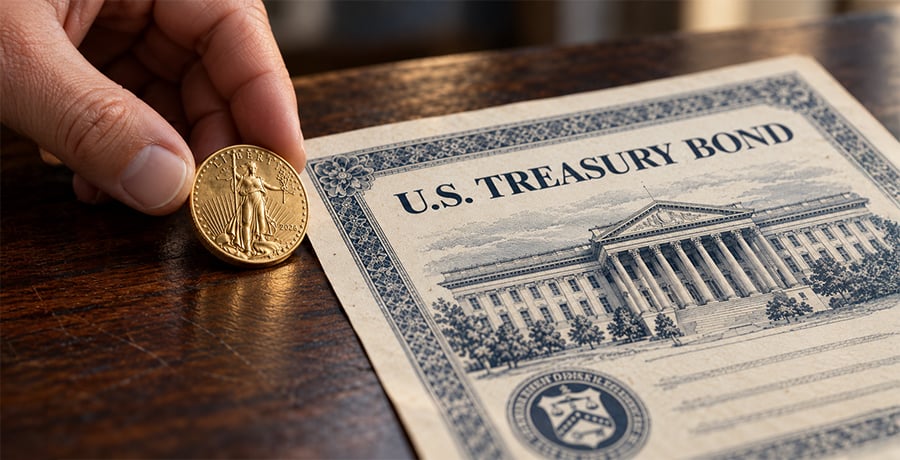
A Treasury bond represents a promise from the U.S. government to repay borrowed money.
Physical gold is a tangible asset. Its value isn’t based on a promise from the government to repay a debt.
So if confidence in America’s long-term financial outlook begins to weaken, investors may respond in different ways.
Some may demand higher interest rates before lending money to the government.
Others may look toward physical gold as an additional way to diversify their holdings.
And some may choose both.
That raises the possibility at the heart of this article: Concerns about the future could contribute to higher Treasury yields and increased physical gold buying at the same time.
And recent physical gold demand figures are worth a closer look.

Q2 2026 gold demand: U.S. bar-and-coin buying up 28% and global central-bank net purchases up 62% year over year 6
The World Gold Council pointed to a possible explanation for continued central bank buying:
“With ongoing heightened uncertainty and a longstanding desire for reserve diversification, this likely helped sustain central bank appetite.” 5
—World Gold Council, Gold Demand Trends Q2 2026
Of course, these figures don’t prove that higher interest rates caused anyone to buy gold. Central banks and individual investors also have different reasons for purchasing it.
The physical gold figures are from Q2, while the latest Treasury-market movements occurred in October. They’re separate observations, not evidence that the two moved together during the same period.
But they show that physical gold continues to attract buyers even in an environment where interest-bearing investments compete for investors’ money.
Higher interest rates can still put downward pressure on gold prices. Gold can lose value, and increased buying doesn’t guarantee that prices will rise.
The relationship between interest rates and gold depends partly on what’s driving investors’ decisions.
For retirement savers, that’s worth understanding.
What Could This Mean for Your Retirement?
You don’t need to follow the bond market every day to feel the effects of changing interest rates.
If you’re retired or approaching retirement, there are three areas worth paying attention to.
- The Bonds Already in Your IRA
Higher interest rates can create new income opportunities for savers buying bonds today.
But what happens to the bonds you already own?
When market interest rates rise, the prices of existing fixed-rate bonds generally fall.
“When market interest rates rise, prices of fixed-rate bonds fall.” 7
—U.S. Securities and Exchange Commission
Why?
Suppose you own a bond paying 3% interest. If newly available bonds offer 5%, your older bond becomes less attractive to someone looking to buy it.
Its market price may need to fall in order to compete.
That’s particularly relevant if your retirement savings include bond funds or longer-term bonds that you may need to sell.
Individual Treasury bonds held to maturity generally continue paying according to their terms, and investors ordinarily receive the stated principal at maturity.
So, higher yields can create opportunities for some savers while reducing the market value of existing bonds.
- How Far Your Retirement Income Will Stretch
Earning more interest sounds appealing.
But think about what’s really important when you’re retired.
Can that income still cover groceries, utilities, insurance, travel, and the life you’ve planned?
If inflation remains elevated, even a higher interest rate may not translate into greater purchasing power.
And here’s where the trust question becomes personal.
You may trust that the government will repay its bonds. But how much will those future dollars buy?
For someone relying on retirement savings over the next 20 or 30 years, that’s an important distinction.
Your retirement depends on more than how much money your investments earn.
It also depends on what that money will be worth when you need it.
- The Role Physical Gold Could Play
This brings us back to gold.
Bonds can provide interest income. Stocks offer opportunities for long-term growth. Physical gold may provide an additional source of diversification.
Each serves a different purpose and comes with different risks.
Physical gold doesn’t generate interest or dividends, and its market price can fluctuate significantly. Buying, selling, and storing it can also involve costs.
For qualified savers considering a Gold IRA, certain physical gold coins and bullion can be held through an appropriately structured retirement account, subject to IRS requirements for eligible metals and custodial possession.[8]
The question is whether physical gold could serve a useful role alongside your other retirement holdings, especially when you’re concerned about government debt, inflation, and purchasing power.
So, Can Interest Rates and Gold Buying Rise Together?
Yes. And understanding why they might rise together is more useful than trying to predict the next move in either market.
When Treasury yields rise because the economy is strong, interest-paying investments may become more attractive.
But if growing concerns about America’s debt, inflation, and long-term financial outlook are also contributing to higher yields, some investors may become more interested in physical gold.
Neither outcome is guaranteed.
And this week’s Treasury rally is a reminder that confidence can change quickly, depending on what investors are worried about.
So, the next time you hear that government bond yields are rising, ask yourself why.
Is the economy growing stronger? Are investors worried about inflation? Or are they becoming less comfortable with America’s financial future?
Changes in confidence can reach beyond the bond market, influencing whether investors consider owning physical gold.
For retirement savers, understanding those connections may be more valuable than trying to guess where interest rates or gold prices will go next.

Our mission is to educate and empower investors across America to protect their retirement and gain peace of mind for the future.
References
- The New York Times. “The Forces Driving Up Bond Yields Take a Troubling Turn”. October 13, 2026.
- Reuters via Investing.com. “US inflation expectations are well anchored, Fed’s Waller says”. October 13, 2026.
- Financial Times. “Treasuries head for big weekly gains as AI jitters halt bond rout”. October 16, 2026.
- Federal Reserve Bank of New York. “Treasury Term Premia”. Accessed October 16, 2026.
- World Gold Council. “Gold Demand Trends: Q2 2026 — Central Banks”. Sign in Required. July 30, 2026.
- World Gold Council. “Gold Demand Trends: US Focus Q2 2026”. Sign in Required. August 5, 2026.
- U.S. Securities and Exchange Commission, Investor.gov. “Investor Bulletin: Fixed Income Investments — When Interest Rates Go Up, Prices of Fixed-Rate Bonds Fall”.
- Internal Revenue Service. “Retirement Plans FAQs Regarding IRAs”.