
Washington Collected a Record $5.4 Trillion in Revenue. Still $2 Trillion Short.
Key Takeaways
- Washington collected a record $5.40 trillion in federal receipts in fiscal 2026— yet the government spent $7.40 trillion.2
- The deficit jumped 12% ($217 billion) in a single year, marking the third-largest budget shortfall in American history.3
- Net interest on the national debt officially crossed $1.05 trillion — surpassing the entire U.S. defense budget ($965 billion).4
- Net interest costs were equivalent to more than half of the entire $1.99 trillion annual deficit.4
- Four ripple effects connect this $2 trillion shortfall to your IRA — and physical gold.
Imagine a household bringing home the biggest paycheck of its life — and still maxing out its credit cards by the end of the year.
On October 16, the U.S. Department of the Treasury released its final year-end accounting for Fiscal Year 2026.1 The report revealed a financial paradox that every retirement saver should sit with for a moment.
Over the past twelve months, American taxpayers and businesses sent Washington a record $5.40 trillion in tax revenue — including $2.88 trillion in individual income taxes alone.2
Even record federal revenue wasn’t enough to cover Washington’s spending. It spent $7.40 trillion over those same twelve months, leaving a $1.99 trillion (nearly $2 trillion) annual budget deficit.2
“Today’s deficit figures cap off a remarkably dismal year for our fiscal health… Tough choices will be needed to get there, and we’re running out of time to make them.” 3
— Maya MacGuineas, President, Committee for a Responsible Federal Budget
Earlier this summer, headlines focused on the total national debt crossing the $40 trillion milestone.3 If $40 trillion is the size of the mountain, a $2 trillion annual deficit is the speed at which that mountain is growing.
And a gap that wide doesn’t stay trapped inside D.C. Here’s what is really driving the $2 trillion overspend — and four direct ways it reaches your retirement savings.
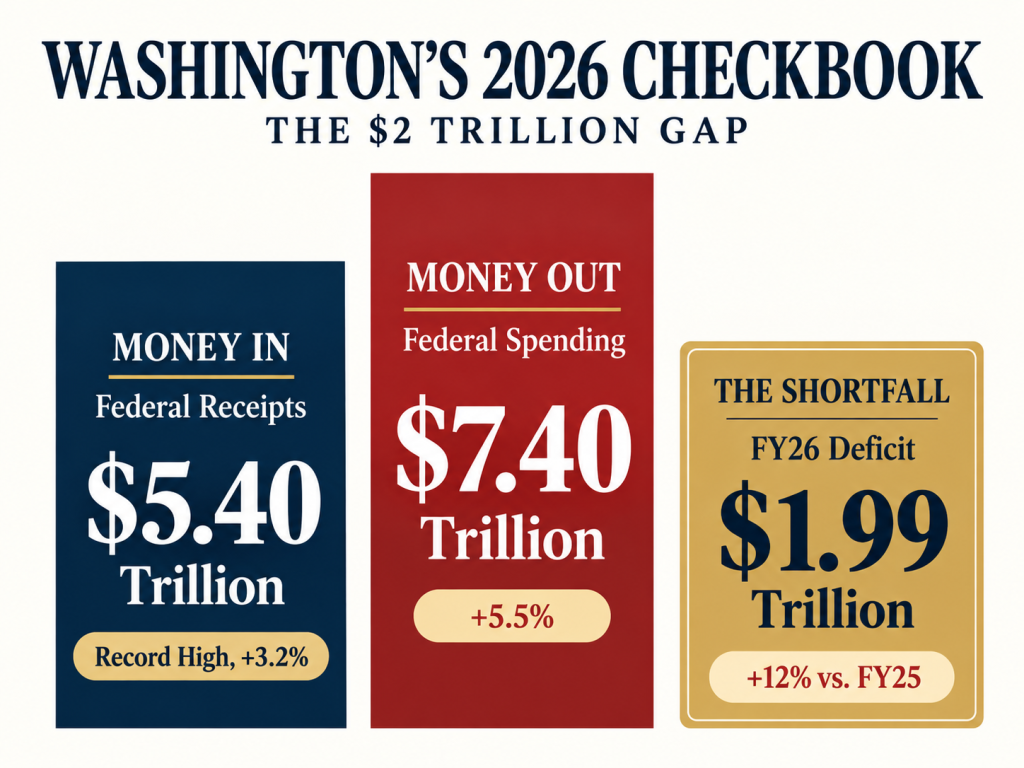
Despite collecting record federal revenue, federal spending outpaced receipts by nearly $2 trillion. Source: U.S. Department of the Treasury.1
Where Interest Costs Matter (They Exceeded Half the Deficit)
When most people hear that the government ran a $2 trillion deficit, they assume the money went toward new highways, border security, or military equipment.
The Treasury’s year-end ledger tells a much more sobering story.
In Fiscal Year 2026, net interest on the public debt officially reached $1.05 trillion (with gross interest expenses climbing to $1.36 trillion).4 For the full fiscal year, Washington spent more money paying interest on old debt ($1.05 trillion) than it spent on the entire U.S. military and national defense ($965 billion).4
Think about that math in household terms: net interest alone was equivalent to more than 52% of the entire $1.99 trillion deficit.4 Washington spent over a trillion dollars servicing existing debt rather than funding new federal programs.
4 Direct Ways a $2 Trillion Deficit Can Reach Your Retirement
- The “Silent Partner” in Your 401(k) Needs More Revenue
If your retirement savings sit inside a traditional tax-deferred 401(k), IRA, or TSP, you have a silent partner in that account: Uncle Sam. You haven’t paid taxes on that money yet, and Congress gets to decide what your tax bracket will be when you withdraw it.
When Washington collects a record $5.4 trillion in federal revenue and still comes up $2 trillion short, the pressure on lawmakers to find new tax revenue only intensifies.3 For savers who worked decades to build a nest egg, future tax rates are one of the biggest wildcards in retirement planning.
- A $2 Trillion Deficit in “Good” Times Leaves Less Fiscal Room
Historically, America only ran $2 trillion deficits during once-in-a-generation emergencies, like the 2020 pandemic shutdowns.2 Today, the U.S. is running a $2 trillion deficit during peacetime, with no recession on the books.3
“Such extraordinarily high deficits are just one piece of our fiscal situation that is falling apart.”
— Maya MacGuineas, President, Committee for a Responsible Federal Budget 3
If the government has to borrow $2 trillion a year when the economy is supposedly steady, what happens to federal borrowing — and the value of the U.S. dollar — the moment the next economic slowdown arrives?
- Everyday Living Costs Stay Stubbornly High
To finance a nearly $2 trillion deficit, the Treasury issues government debt.1 Large federal deficits can add to inflationary pressure, particularly when government spending contributes to excess demand.
In September, the Federal Reserve raised its target interest rate to a range of 3.75%–4.00%, while annual U.S. consumer-price inflation reached 3.7%.9 For retirees living on fixed withdrawals, inflation acts like a hidden tax — quietly reducing what each dollar in your bank account buys at the grocery store, the gas pump, and the pharmacy.
- “Safe” Paper Bonds Face a Flood of Supply
Many retirement accounts hold government bond funds for safety. Heavy Treasury borrowing can put upward pressure on yields, although inflation expectations and Federal Reserve policy also matter. By September 30, 2026, the 10-year Treasury yield had reached 5.29%.10
When yields on new bonds jump that high, older, lower-yielding bonds and bond funds held in retirement accounts can fall in market value.5

Why a $2 Trillion Tab Points Straight to Physical Gold
Every stock, bond, and cash balance in a traditional retirement plan is tied to the paper financial system. A government bond represents money lent to Washington.
Physical gold and silver operate on a completely different foundation.
An ounce of physical gold is one of the only monetary assets on earth that isn’t someone else’s liability. It doesn’t have a budget deficit. It cannot be printed to cover a $2 trillion Congressional shortfall, and it carries no issuer default risk.
Central banks have been net buyers of gold for 16 consecutive years — adding 863 tonnes in 2025 and 289 tonnes in the second quarter of 2026. On October 23, 2026, spot gold traded around $4,000 an ounce.7
Central banks continue to use physical gold for reserve diversification amid economic and geopolitical uncertainty.6
Two Ledgers: Checking Your Own Before Year-End
October is when the U.S. government publishes its year-end fiscal figures for the fiscal year that closed on September 30.1 This year’s ledger closed $2 trillion in the red.2
Before the calendar year wraps up, it makes sense to look at your own retirement ledger.
You don’t need to move every dollar you own out of the market, and no asset — including gold — is guaranteed to rise in every environment. The goal is making sure your 20-to-30-year retirement doesn’t depend on Washington suddenly learning how to balance its checkbook.
If you have $50,000 or more in an IRA, 401(k), or TSP and want to see how physical gold and silver can fit within an eligible, tax-advantaged self-directed IRA, we put together our free 2026 Gold & Silver IRA Info Kit to walk you through the facts at your own pace.
Inside your complimentary kit, you’ll see:
- How savers are moving a portion of their IRA or 401(k) into physical gold and silver tax-free and penalty-free under standard IRS rules.
- Why physical bullion behaves differently than paper bond funds when federal deficits and interest costs climb.
- How to access a private, one-on-one educational web conference with Augusta Precious Metals salaried economic educators — with zero sales hype and zero obligation.
👉 Get Your Free 2026 Gold & Silver IRA Info Kit Here →
Disclaimer: Augusta Precious Metals is an educational resource and physical precious metals specialist. The information provided in this article is for educational purposes only and should not be considered personalized financial, tax, or investment advice. Precious metals, like all investments, carry risk and can fluctuate in value. Past performance is no guarantee of future results. Consult with your personal financial and tax advisors before making any portfolio allocation decisions.

Kindra Foster is a senior communications lead at Augusta Precious Metals, where she develops educational resources focused on retirement, gold IRAs and diversification. With nearly two decades of experience in financial and retirement communications, Kindra served as a senior writer for Mutual of Omaha’s insurance and investment divisions and for a regional assisted living management company. At Augusta, Kindra works closely with financial experts to create retirement education materials that are accurate, balanced, and compliant.
References
- U.S. Department of the Treasury, Bureau of the Fiscal Service. “Final Monthly Treasury Statement of Receipts and Outlays of the United States Government for Fiscal Year 2026 Through September 30, 2026.” Released October 16, 2026.
- CNBC. “U.S. budget deficit swells to almost $2 trillion for fiscal 2026, up 12% in a single year.” October 16, 2026.
- Committee for a Responsible Federal Budget (CRFB). Maya MacGuineas statements: “Treasury Confirms $2 Trillion Deficit for Fiscal Year 2026.” (October 16, 2026); “CBO Estimates $2.0 Trillion Deficit for First 11 Months of FY 2026.” (September 9, 2026).
- Congressional Budget Office (CBO). “Monthly Budget Review: September 2026.” Publication 61985, October 8, 2026.
- U.S. Securities and Exchange Commission (SEC). “Investor Bulletin: Fixed Income Investments — When Interest Rates Go Up, Prices of Fixed-Rate Bonds Fall.” Accessed October 23, 2026.
- World Gold Council. “Gold Demand Trends: Q4 and Full Year 2025” (January 29, 2026) and “Gold Demand Trends: Q2 2026 — Central Banks” (July 30, 2026). Accessed October 23, 2026.
- Kitco News. “Gold set for steep weekly loss as rising oil prices bolster Fed rate hike bets.” October 23, 2026.
- Federal Reserve Board. “Federal Reserve Issues FOMC Statement.” September 16, 2026.
- U.S. Bureau of Labor Statistics. “Consumer Price Index — September 2026.” Released October 14, 2026.
- U.S. Department of the Treasury. “Daily Treasury Par Yield Curve Rates.” September 30, 2026.