The AI Boom Runs on Gold — and It’s Reaching Your Retirement
Key Takeaways
- Gold sits inside AI servers — the bonding wire, connectors, and boards.1
- Gold hit 53 record highs in 2025, and AI kept technology demand climbing anyway.2
- AI’s driving up power, chip, and tech prices — about $375 per household each year.4
- Global gold demand topped 5,000 tonnes for the first time on record in 2025, with central banks buying 863 tonnes.2
- Physical gold in an IRA offers a hard-asset hedge as tech spending pressures the dollar.
Most of the AI conversation right now points at silver.
On the surface, that fits. Silver carries electric current better than any other metal, powers the solar panels, and turns up in nearly every device the boom depends on.
But while the tech sector consumes silver by the ton, the AI revolution has an overlooked reliance on a metal with a different superpower: physical gold.
There’s a reason gold shows up throughout the hardware that runs artificial intelligence. A thin layer helps resist corrosion, prevent tarnish and keep electrical connections reliable. When an artificial intelligence system runs day and night, and one failed connection can crash a multimillion-dollar job, gold-plated connectors are a recommended choice.1
That reliance draws a direct line between AI and gold — one that starts deep inside a processor and reaches all the way to your power bill, your grocery receipts, and your retirement account.
The Gold You Didn’t Know You Owned
Open your laptop. Pick up your phone. Picture the server humming inside a data center three states away. Somewhere in each one, there’s gold plating.
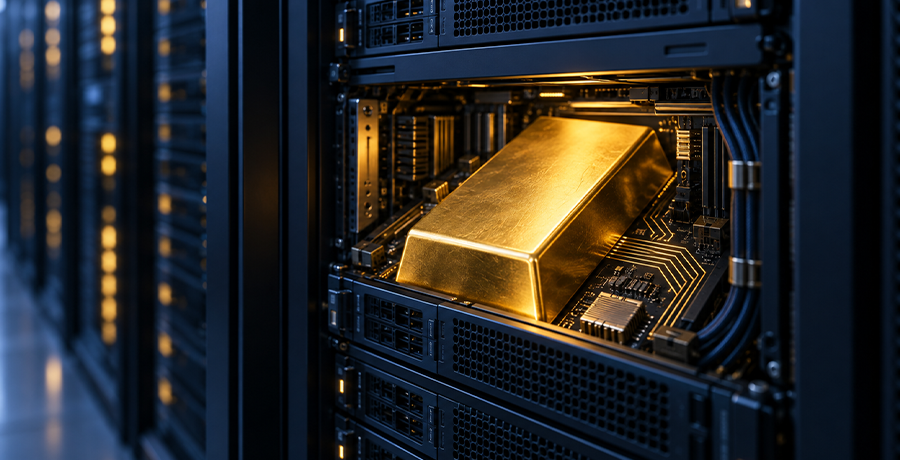
It’s in the bonding wire thinner than a human hair. It’s in the connectors, the contacts, and the circuit boards.1
The World Gold Council notes AI infrastructure was the dominant growth engine for high-end electronics, with gold demand supported by premium AI server mainboards and advanced semiconductors.3 There’s only a trace of gold in any one device. But the AI boom is building billions of devices.

Silver and gold help AI hardware perform reliably. Source: TE Connectivity Engineering Analysis1, Silver Institute6
53 Record Highs, and Tech Companies Kept Buying
Usually, when raw materials get expensive, factories find cheaper alternatives.
Gold gave them every reason to switch. In 2025, gold went on a wild run. The price set 53 separate record highs, and by the end of Q4 it averaged around $4,135 an ounce — up roughly 55% from the year before.2
The buying continued anyway. In the second quarter of 2026 alone, electronics makers used 68 tonnes of gold, up 4% from the year before.3 Even with prices near all-time highs, the rush to build AI hardware forced companies to keep buying.
“Demands from AI infrastructure remained the dominant growth engine for high-end electronics.” 3
—World Gold Council
When a multi-trillion-dollar global electronics industry,8 pays top dollar for physical gold , it shows just how valuable the physical metal still is in our modern world.
How the AI Boom Reaches Your Wallet
The link between AI and gold extends far beyond the inside of a computer.
Companies are pouring roughly $750 billion into AI adoption this year alone.4 That enormous expense is passed on to normal households and creates shortages for real people.
- Higher Power Bills: Data centers used about 4.4% of all US electricity in 2023, and federal researchers expect that number could reach as much as 12% by 2028.7 To build bigger power grids for data center computers, local power companies are raising prices, pushing residential rates up about 4%.4
- Higher Tech Costs: Wholesale prices for semiconductors and other electronic component manufacturing jumped around 26% from a year ago,4 as suppliers sent their best stock to deep-pocketed AI data centers ahead of everyday buyers. Apple raised prices on some consumer products about 20%. Microsoft lifted Xbox prices about 25%. Even Office 365 climbed 43% once its AI features arrived.4
“Prices have risen significantly for chips, other high-tech equipment, and software.” 5
—Lisa D. Cook, Federal Reserve Governor
All those price hikes add up to real money. It amounts to everyday families footing part of the bill for this tech expansion:
“Households must spend just over $375 more to purchase the same goods and services.” 4
—Mark Zandi, Chief Economist, Moody’s Analytics
That $375 is a small slice of overall inflation on its own — AI accounts for only about 0.2 percentage points today.4 But economists worry about how far it spreads from here. And on a fixed retirement income, even a few hundred dollars a year chips away at the life you planned.
Why the AI Boom Points Straight to Retirement Protection
As AI reshapes the economy, you’re still counting on your savings to fund the retirement you planned. The AI buildout is already affecting that plan — through the price of nearly everything you buy.4
When costs climb faster than a fixed income, each dollar you’ve saved covers a little less. That can mean fewer trips, fewer visits with family, less of the retirement you spent decades building.
So, what could help your savings hold their purchasing power as costs rise?
Gold’s long-term record is one reason it belongs in this conversation. World Gold Council research shows that since 1971, gold outpaced US consumer-price inflation.10 In plain terms, gold hasn’t just kept up with the cost of living— it’s stayed ahead of it.
And in 2025, the world’s central banks added 863 tonnes of gold to their reserves, helping push total global gold demand past 5,000 tonnes for the first time on record.2 These are the institutions that manage national wealth. The World Gold Council points to diversification and inflation hedging as key reasons central banks hold gold.3
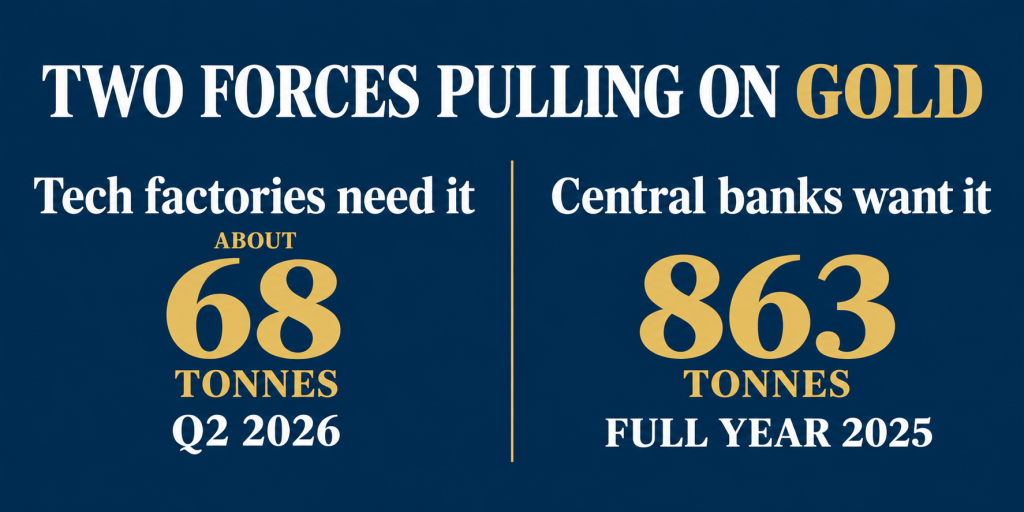
Gold connects advanced technology with national reserves. Source: World Gold Council3
That’s the AI boom in focus: gold works inside the technology being built, and it holds value even as that same buildout adds to what you pay as a consumer. Inside a self-directed IRA, gold can sit alongside the rest of your retirement savings as a tangible asset outside the paper system.
None of this points to a single right answer. Your timing, your goals, and your comfort with risk all shape the decision. What’s clear is that the moment to understand where gold fits is right now.
Start With the Questions You Want Answered
When you’ve spent decades saving, you want to understand what could affect that money — and what your options are.
If the connection between AI, gold, and your retirement has you curious about physical metals, a few practical questions naturally follow. What would you own? What would it cost? What should you know before choosing a company?
We created Augusta’s free 2026 Gold & Silver IRA Info Kit to help you get clear answers to those questions.
Inside, you’ll find four essential guides with straightforward information about physical gold and silver, gold and silver self-directed IRAs, and what to look for before choosing a provider.
Request your free kit and explore it at your own pace.
Get Your Free 2026 Gold & Silver IRA Info Kit »
For qualified savers considering $50,000+ in physical gold and silver.

References
- TE Connectivity. “Overview about PdNi Plating as Alternative of Gold Plating.” Accessed September 9, 2026.
- World Gold Council. “Gold Demand Trends: Q4 and Full Year 2025.”January 2026.
- World Gold Council. “Gold Demand Trends: Q2 2026.” July 2026.
- CNN Business. “AI is making your life more expensive. Here’s how.” July 28, 2026.
- Federal Reserve Board. “Speech by Governor Lisa D. Cook on AI, the Economy, and the Financial System.” May 2026.
- The Silver Institute. Silver, The Next Generation Metal. Accessed September 10, 2026.
- U.S. Department of Energy / Berkeley Lab. “DOE Releases New Report Evaluating Increase in Electricity Demand from Data Centers.” Federal Research Release, December 2024.
- MoneyWatch via CBS News. “Big Tech is spending trillions on AI. Investors now want proof it will pay off.” June 26, 2026.
- World Gold Council. “Gold Market Primer: Market size and structure.” August 2026.
- World Gold Council. “Gold as a strategic asset: 2025 edition.” Accessed September 10, 2026.