Silver Strength: EV Battery to Energize Metal Demand?
- New EV batteries could increase range, improve safety.
- Implications for silver consumption could be substantial.
- Development comes as silver already facing supply deficit.
- Silver’s “EV bull story is here”: says analyst.
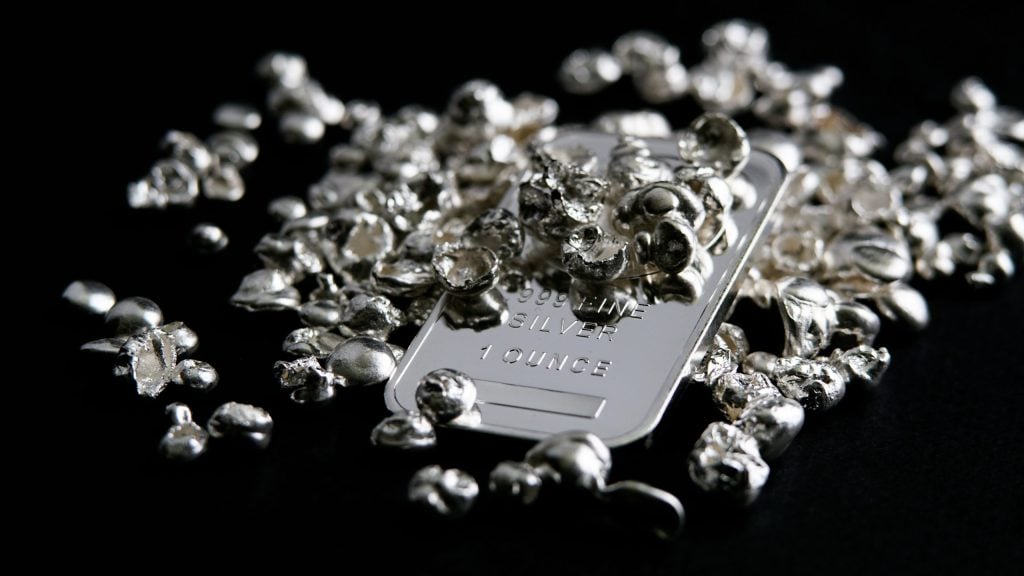
As is typically the case when the precious metals bull begins to charge, it’s gold that garners most of the headlines. That certainly is the case this time around, as well, with recent performance numbers serving as part of the reason.
It’s true that gold and silver are both up around 23% year to date (through Friday).[1] But go back a little further, to 2022 – which some analysts say is the real beginning of the current bull run – and you’ll find gold was up roughly 40% while silver rose nearly 30%.[2]
Although gold often is the better performer over more extended time periods, silver certainly has been no slouch. Part of the reason is that because it also is a precious monetary metal, silver has the core properties to respond similarly to gold when geoeconomic conditions morph in a metals-favorable way.
But silver is not only a precious metal. Silver is prized as an industrial metal, as well. And so while some of the enthusiasm for silver expressed by many analysts this year is rooted in its potential to respond as a perceived store of value in the way that gold can, another reason for the enthusiasm is based on the outlook for silver as an essential industrial metal.
What makes silver so popular to industry is its ability to conduct electricity. Silver is, in fact, the world’s best conductor of electricity.[3] Because of this, and in light of the worldwide green energy push that itself is so reliant on electricity, the industrial demand for silver now makes up 55% of the metal’s overall demand.[4]
And that industrial demand could account for the consumption of a lot of silver this year: After climbing 11% last year to reach a new all-time high, industrial demand for silver is projected to rise another 9% this year to another new record high, according to The Silver Institute.[5]
The solar energy industry, in particular, is forecast to provide much of the momentum for silver’s industrial demand, going forward. According to a recent report by Maria Smirnova of Sprott Asset Management, the demand for silver from solar photovoltaic manufacturers is forecast to rise 170% through 2030.[6]
And as if the projected future for silver wasn’t rosy enough from the perspective of demand, it seems the supply story potentially could have a happy ending for the metal’s near-term prospects, as well. Silver has faced a chronic supply shortage for years, which has contributed to a market deficit now in its fourth consecutive year. What’s more, that deficit is forecast to increase by another 17% in 2024.[7]
And it is against this rather robust, existing backdrop that word now comes of yet another reason for analysts to be optimistic about silver’s industrial demand outlook.
Several strategists recently have been crowing about a new technological evolution from Samsung that could trigger even greater demand for the white metal than that already projected: a solid-state battery that experts say has the potential to revolutionize an electric vehicle (EV) industry plagued by what has been, up to this point, relatively unimpressive battery technology.
One of the challenges to widespread EV acceptance has been issues related to battery functionality, including safety (fires have been a concern) as well as power capacity. But the new Samsung battery is being hailed as a “game-changer,” as far as all that goes.[8]
As a technological advancement, the implications for the EV industry could be very significant. And according to a number of analysts, the implications for the price of silver – a critical component of the Samsung batteries – could be substantial, as well…particularly given the optimism that analysts like Maria Smirnova already have expressed for the metal’s prospects.
So, what is all the fuss over this new Samsung battery?
Let’s find out.
New Battery Technology Could Mean 600 Miles on a Single Charge
Longer range. Faster charging times. Greater safety. These may be the three most sought-after features in EV batteries. Up to this point, they’ve remained elusive to EV manufacturers as well as, of course, EV customers. But that could be about to change.
At a recent expo in Seoul, South Korea, Samsung unveiled a solid-state battery that appears to deliver on all three components of the EV wish list. And what that development means for both the EV industry and silver investors is potentially very significant.
The core of the benefit is in the battery’s solid-state technology, which enables the unit to have roughly double the energy density of current chemical-filled lithium batteries. This improvement translates into a vastly improved vehicle range on a single charge – 600 miles vs. the current 300 miles (roughly) – as well as longer battery lifespan (20 years vs. 12-15 years).[9]
That’s not all. Currently, lithium-powered EVs can take 15 to 20 minutes (or more) to charge. The new Samsung battery is fully charged in about 9 minutes. And the nature of the solid-state technology is such that the battery is far safer, all but eliminating the chances of battery fires. That’s because there’s no role in the new design for the flammable liquid electrolyte currently used in lithium batteries to transport ions within the battery unit.[10]
The new batteries aren’t ready for the marketplace just yet, however. For one thing, the solid-state batteries have a higher production cost than their lithium counterparts. There also are said to be challenges in scaling up the mass production of the new units. But the consensus is that the significance of the technological advancement represented by the solid-state batteries is such that these are issues that can be successfully negotiated. Which means it’s likely they will represent the next generation of EV power packs.[11]
In fact, as automotive journalist Enrico Punsalang recently noted, Samsung already is making alliances with large automakers to see their batteries in the new EVs to come.
“Toyota and Samsung have agreed to begin mass production of SS batteries in 2027,” writes Punsalang, “with Toyota noting that its premium Lexus vehicles will be among the first to benefit from this new tech.”[12]
The rapidly growing enthusiasm for the potential of the new batteries as EV energy sources brings us to the rapidly growing enthusiasm on the part of precious metals strategists as far as what the development could mean for silver.
Analyst: New EV Batteries Potentially Could Consume 60% of Silver’s Current Annual Global Production
“Silver’s exceptional electrical conductivity and stability are leveraged to enhance battery performance and durability, achieving amazing benchmarks like a 600-mile range and a 20-year lifespan and 9-minute charge,” Kevin Bambrough, former market strategist at Sprott, crowed recently.[13]
Citing estimates that the new batteries could demand about 1 kilogram (2.2 pounds) of silver per vehicle, Bambrough went on to do some extraordinary math about the implications of those requirements for overall silver consumption.
“With global car production standing at about 80 million vehicles per year, if 20% of these vehicles (16 million EVs) were to adopt Samsung’s solid-state batteries, the annual demand for silver would be around 16,000 metric tons (16 million vehicles * 1 kg of silver per vehicle),” Bambrough said. “This would represent a significant portion of the current global silver production, which is approximately 25,000 metric tons annually, highlighting the substantial impact on the silver market.”[14]
Bambrough went on to put this development in the context of both the aforementioned demand for silver by the solar industry as well as the ongoing supply deficit.
“Add in the fact that silver is already in a deficit with industrial demand from the solar industry pushing total yearly consumption ahead of supply,” Bambrough said. “So we don’t even have any silver capacity to spare!”[15]
Charlie Morris, founder of the investment research website ByteTree, sees potential parallels with the strength demonstrated by silver in 2010, when the nascent recovery of the global economy saw industrial demand for the white metal soar 20% that year.[16] As it turns out, silver was – with room to spare – the best performing asset in 2010.[17]
“This reminds me of the silver rally of 2010, which saw the price surge to $50 on the back of demand for solar panels,” Morris said.[18]
“The EV bull story is here and now, and if solid-state EV batteries can invigorate the crowd, silver is onto a winner,” he added. “The silver price basically matches gold, but goes further, not just in bull markets, but whenever there’s a good story. I like this one.”[19]
Some grassroots investors may like the story, as well. The fact is that silver – sometimes referred to as gold’s “poorer cousin” – has told a lot of interesting stories through the years.[20]
Silver “Slingshot” Past Gold During Economic Recoveries from Pandemic and Financial Crisis
There’s the story it told in 2020, when the fallout from the global health crisis effectively paralyzed the worldwide economy for a time during the first half of the year.[21] Outperformed by gold through July, silver eventually surpassed the yellow metal because, according to some analysts, silver saw an uptick in its industrial demand as economies began to reopen.[22] By the end of 2020, gold had appreciated roughly 25% while silver climbed nearly 50% that year.[23]
Then there are the years of the global financial crisis. From December 2007 to June 2009, gold managed to solidly outperform silver. But by midway through 2011, as economies were beginning to recover, silver had appreciated nearly 150% over that stretch, while gold climbed 90%.[24]
As a precious metal, silver has the same general properties as gold, which means it has the potential to react as a perceived store of value in the way that gold can during periods of economic distress. But silver’s tremendous utility as an industrial metal also means it has the potential to surpass gold during precious metals bull runs when economic distress gives way to economic recovery.
For that reason, some investors considering precious metals may conclude that they’re better served by owning silver in addition to gold, or perhaps even instead of gold, depending on their own worldview of the economy.
The good news for them is that adding silver to their asset inventory is as easy as adding gold. Just as with gold, investors can purchase their silver outright for cash, which affords them the greatest degree of flexibility when it comes to storage choices. And in the same way that investors can choose to purchase their gold in a tax-advantaged retirement account known as a gold IRA, they can buy silver in precisely the same way.
As compelling as some analysts consider the solid-state-battery opportunity in silver to be, it is unknown if the prospective circumstances detailed by Kevin Bambrough and others ultimately will play out as imagined. Perhaps the more important issue for investors to resolve is if they at least see a place in their portfolio for an asset uniquely situated to serve as both a potential store of value and critical industrial component. If they do, then the specific possibilities presented by Samsung and the other solid-state battery manufacturers to come may prove to be but one of many reasons for those investors to consider a core position in silver.
[1] CNBC.com, “Gold COMEX (Dec′24)” (accessed 8/22/24); CNBC.com, “Silver COMEX (Sep′24)” (accessed 8/22/24).
[2] Yahoo Finance, “Volatility could push gold to $3,000 per ounce: Strategist” (August 12, 2024, accessed 8/22/24); CNBC.com, “Gold COMEX (Dec′24)”; CNBC.com, “Silver COMEX.
[3] Tampa Steel, “Which Metal is the Best Conductor of Electricity?” (accessed 8/22/24).
[4] Maria Smirnova, Sprott, “Silver’s Critical Role in the Clean Energy Transition” (May 29, 2024, accessed 8/22/24).
[5] The Silver Institute, “World Silver Survey 2024” (accessed 8/22/24).
[6] Smirnova, Sprott, “Silver’s Critical Role.”
[7] Polina Devitt, Yahoo Finance, “Global silver deficit to rise in 2024 due to higher demand, lower supply” (April 17, 2024, accessed 8/22/24).
[8] Andrew Koopman, TopSpeed, “The Real Story Behind Samsung’s 600-Mile Solid-State Battery” (August 10, 2024, accessed 8/22/24).
[9] Sean O’Meara, Asia Financial, “Samsung Rolls Out 600-Mile Range Solid State Battery – NC” (July 29, 2024, accessed 8/22/24).
[10] Koopman, “The Real Story Behind Samsung’s 600-Mile Solid-State Battery.”
[11] Ibid.
[12] Enrico Punsalang, RideApart, “Samsung Just Showed a 600-Mile Solid-State EV Battery, Charges in 9 Minutes” (July 31, 2024, accessed 8/22/24).
[13] Jordan Finneseth, Kitco News, “Silver set to soar on Samsung’s solid-state battery breakthrough – analysts” (August 19, 2024, accessed 8/22/24).
[14] Ibid.
[15] Ibid.
[16] Alix Steel, The Street, “What’s Moving Silver’s Price to $40?” (April 8, 2011, accessed 8/22/24).
[17] StockCharts.com (accessed 8/22/24).
[18] Finneseth, “Silver set to soar.”
[19] Ibid.
[20] Sam Meredith, CNBC.com, “Gold prices could keep climbing — but analysts expect silver to steal the show before long” (March 11, 2024, accessed 8/22/24).
[21] Gita Gopinath, IMF.org, “The Great Lockdown: Worst Economic Downturn Since the Great Depression” (April 14, 2020, accessed 8/22/24).
[22] Jeff Benjamin, Investment News, “Silver rally quietly outshines gold in 2020” (July 27, 2020, accessed 8/22/24).
[23] StockCharts.com.
[24] Ibid.

After years of assisting American seniors with financial needs, Isaac Nuriani developed a personal mission: to empower the public with knowledge about potential retirement concerns caused by economic policies that favor big banks rather than individual retirement savers. He launched Augusta Precious Metals to give retirement savers the education and tools to diversify their savings through precious metals products. Mr. Nuriani’s vision of quality service includes a strict commitment to ethics and professionalism. He is known as an advocate for silver and gold IRAs to help retirement savers diversify their savings. He earned an economics degree with honors from the University of California, Los Angeles, and now serves as a mentor and guide to industry professionals who share his deep dedication to American retirement stability.