France Took Its Gold Back From America.
Nobody Noticed.
A decades-long shift just finished — offering a rare lesson about protecting wealth when it matters most.
Key Takeaways
- France finished bringing the last of its New-York-held gold under direct control in Paris, completing a move decades in the making.1
- The move generated roughly $15 billion in gains while keeping France’s total gold reserves intact.1
- France isn’t alone — other countries have made similar moves, while central banks keep buying gold even at record prices. 3
——————————————
The Move That Didn’t Make Headlines
Between July 2025 and January 2026, France did something remarkable.
And almost nobody covered it.
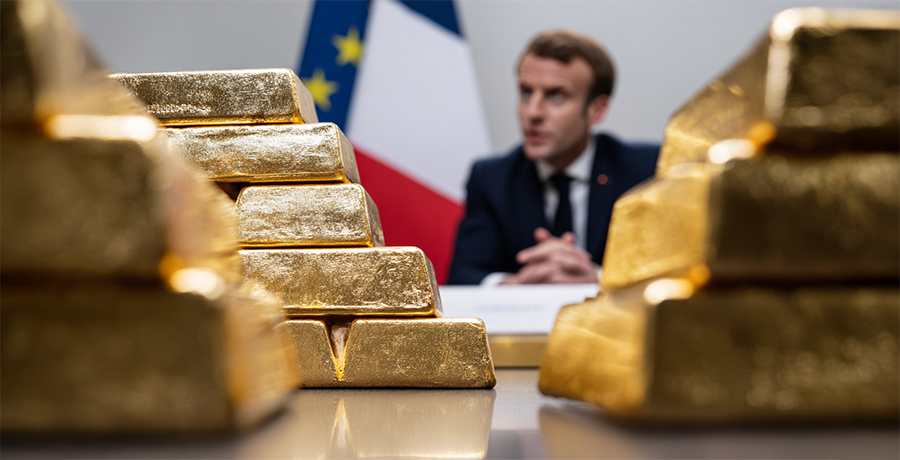
The Banque de France quietly completed the transfer of its remaining gold from the Federal Reserve Bank of New York back to Paris. France’s full 2,437-tonne gold reserve now sits in Paris.1
For the first time in nearly a century, France’s gold is entirely under French control.
There were no press conferences or dramatic declarations. Just a steady, deliberate decision to take back one of the most valuable assets a nation can hold.
Bringing the gold home was the easy part. But the bigger story is what the move says about trust, control, and how serious institutions prepare for risk before the public catches on.
What France Actually Did
Some of France’s gold had been sitting in New York since the late 1920s.
That made sense once. It doesn’t anymore.
Following a 2024 internal audit, the Banque de France decided it was time to finish the job.1
Rather than ship aging, nonstandard bars across the Atlantic, France sold its older gold at today’s record-high prices — and used the proceeds to buy newer, higher-purity bars on European markets.
Same reserves. Higher quality. And a capital gain of roughly $15 billion.1
The governor of the Banque de France made it clear: This was a financial and operational decision — not a political one.1
But the principle behind it says something far more interesting than the accounting does.
The Trend Runs Deeper Than One Country
France didn’t invent this move.
Germany did it. The Netherlands did it. Austria did it, too.2
Nation after nation — close U.S. allies, G7 members, Western economies — have quietly decided to bring the remaining portion of their gold home.
This isn’t defiance against America. It’s risk management.
In a world of geopolitical tension, economic sanctions, and shifting alliances, direct physical control over a strategic asset carries weight it didn’t carry a generation ago.
These are deliberate decisions — made by institutions whose job is to protect national wealth across decades.
What Central Banks Are Telling the World
For several years running, central banks globally have been consistent net buyers of gold — even as prices hit record-highs.3
Not one or two countries. Dozens. At prices most retail investors called too expensive.
There’s a reason this has become pattern. Countries are looking for ways to reduce their risk.
That tells you something important. Central banks do not view gold as a trade. They view it as reserve protection.
Gold serves a different purpose from foreign currency reserves. It’s not someone else’s liability. It doesn’t depend on any one government’s policy choices.
And when it is held at home, it stays under direct national control.
That helps explain France’s move. France was not making a dramatic statement. It was doing what more reserve managers are doing: reducing dependence on assets and systems controlled somewhere else.
“Central bank purchases of 863t reached the upper end of our expected 2025 range; they remain historically elevated and geographically widespread.”
— World Gold Council, 2025 survey
For now, the U.S. dollar remains the world’s dominant reserve currency — that isn’t changing overnight.
But the dollar’s share of global reserves has been gradually declining as more nations seek assets that carry no counterparty risk — assets that don’t depend on any single government’s decisions.
Gold has filled that role throughout history during times of uncertainty. It’s filling it again now.
What This Means If You’re Saving for Retirement
Central banks treat gold as a backstop. An asset that doesn’t depend on any government’s promise. Any bank’s balance sheet. Any political cycle.
Most retirement savers are heavily concentrated in dollar-denominated assets — accounts whose real value can erode as inflation, rising debt, and monetary pressure do their work.
The number in your account stays the same. The life that number can buy shrinks year after year.
A gold IRA gives retirement savers access to the same asset class central banks are privately prioritizing — physical gold — held in an IRS-approved structure, as part of a long-term retirement strategy.
France upgraded and secured its reserves while generating a substantial profit in the process.
The institutions protecting generational wealth made a deliberate choice. The question worth asking: what are you doing with yours?
Final Thought
The biggest stories aren’t always the loudest ones.
Sometimes the real signal is a subtle move by a central bank that already knows what most people are still trying to figure out.
If you’ve been wondering whether your retirement savings are too concentrated in paper assets, this is a good time to understand how a gold IRA works and why more Americans are taking a closer look.
Download Augusta Precious Metals Free Gold & Silver IRA Info Kit and see how physical gold may fit into a long-term retirement strategy.

Our mission is to educate and empower investors across America to protect their retirement and gain peace of mind for the future.
References
- Reuters. French central bank books $15 billion gain on gold reserve upgrade. March 25, 2026.
- Bundesbank. “Bundesbank completes gold transfer ahead of schedule.” August 23, 2017. | MarketWatch. “Dutch central bank repatriates some gold reserves.” November 21, 204. | Oesterreichische Nationalbank. “Gold Reserves.” No date on release.
- World Gold Council. “Gold Demand Trends: Q4 and Full Year 2025.” January 29, 2026.