


Gold and Silver for Retirement:
What's the Real Difference?
Paper gold refers to paper-based financial instruments — ETFs, futures contracts, and mining stocks — that track gold’s price without giving the holder ownership of the physical metal. Physical gold is the metal itself: coins or bars you or a custodian actually hold. The distinction is important to understand for retirement accounts because ownership, custody, liquidity, and tax treatment all differ depending on which one you choose.
Free Gold & Silver IRA Info Kit
What Counts as "Paper Gold"?
Paper gold covers a few distinct paper-based product types, and they don’t all carry the same risk:
- Gold ETFs (such as GLD, IAU) — shares that track gold's price; some are backed by allocated physical gold in a vault, others use futures and derivatives
- Gold futures and options — contracts on the future price of gold, used more by traders than long-term holders
- Mining company stocks — equity in companies that mine gold; price is affected by gold's value but also by the company's operations, debt, and management
- Tokenized gold — digital tokens marketed as gold-backed; regulatory oversight and redemption terms vary widely by issuer and aren't standardized
In each case, the holder owns a claim or a security — not the actual metal.

Physical Gold, by Comparison
Physical gold is the coin or bar itself. In a self-directed IRA, IRS-eligible gold and silver must be held by a custodian in an IRS-compliant depository — home storage of IRA metals is not permitted and can trigger penalties.
Side-by-Side Comparison
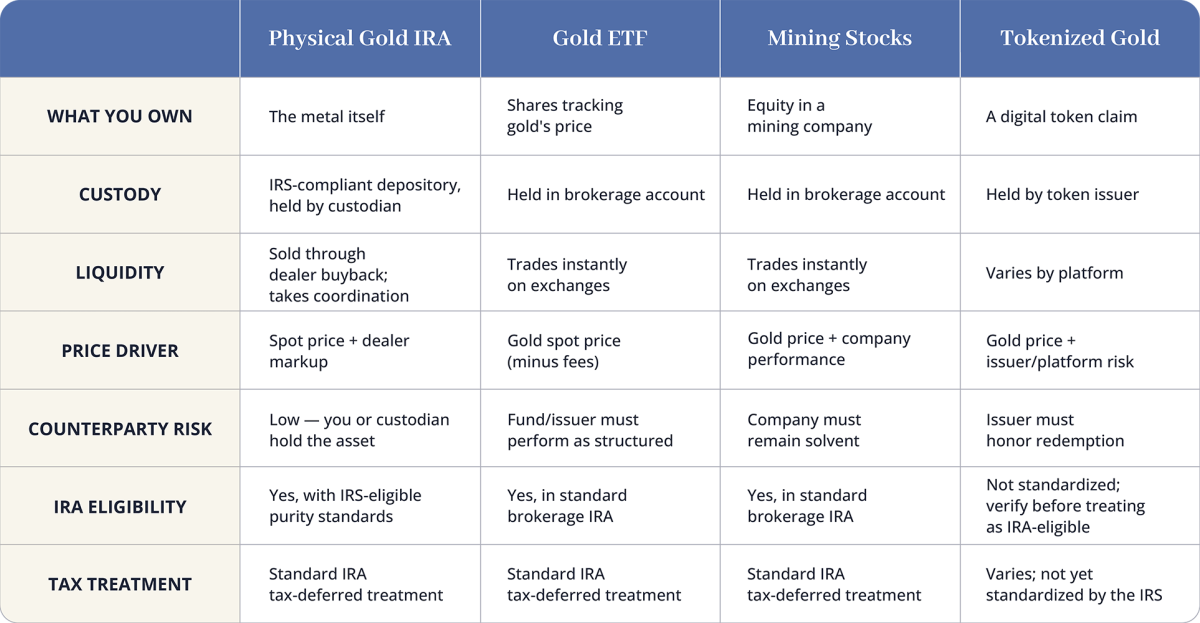

- Tax treatment for any retirement account depends on your specific situation. Consult your personal tax advisor to determine how this investment fits your tax situation.
How the Distinction Affects an Investor’s Decision
An ETF share can be a reasonable way to get exposure to gold’s price. But it depends on the fund operating as structured, the custodian holding what it claims to hold, and the market functioning normally. A mining stock depends on all of that plus a company’s operations and balance sheet. Physical gold held in a self-directed IRA removes those layers and the risks involved — the holder or custodian holds the actual asset directly, not a claim on it.
That doesn’t mean physical gold is risk-free. Its price fluctuates like any commodity, and selling requires going through a dealer rather than clicking “sell” on an exchange. A measured or partial allocation to physical gold may reduce the dependence of a portfolio on any single financial institution performing as expected — it doesn’t guarantee a particular outcome.


Augusta's Perspective
Most retirement savers aren’t trying to choose gold instead of everything else. As Devlyn Steele, the company’s director of education, puts it: “The real question isn’t whether to own only gold — it’s how much of your retirement savings should exist outside paper-based assets if inflation or instability continue long term.”
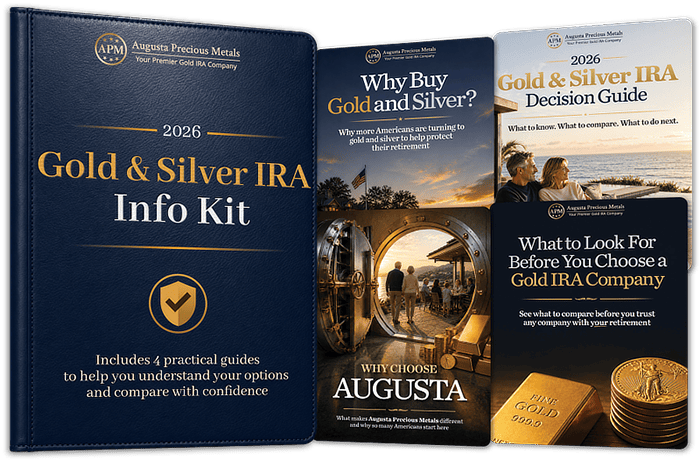
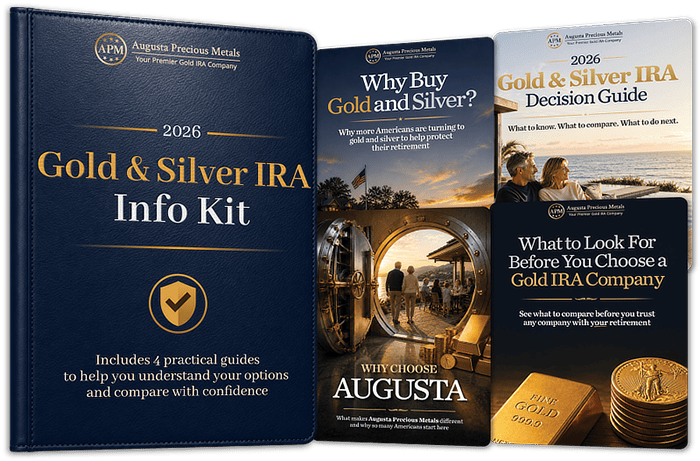
That’s a one-on-one conversation. After reviewing the Gold IRA Info Kit, you have the opportunity to speak one-on-one with a member of our team to get your questions answered.
Augusta’s educators are salaried (they don’t earn commission) — so walking through this distinction is education, not a sales pitch. In a free one-on-one web conference, they’ll address your questions about how much of your retirement should exist outside paper-based assets — with no sales agenda attached to any information they share.
Gold belongs as part of a retirement strategy, not a replacement for one.
FAQ
Is a gold ETF the same as owning gold?
No. An ETF share tracks gold’s price but represents a claim on the fund’s holdings, not direct ownership of metal. Some ETFs hold allocated physical gold; others rely on futures contracts, which carries different risk.
Can I hold physical gold in a regular IRA?
No — physical gold requires a self-directed IRA with a qualified custodian and an IRS-compliant depository. A standard brokerage IRA can hold gold ETFs or mining stocks, but not physical metal directly.
Is tokenized gold IRA-eligible?
Not consistently. Regulatory treatment and redemption terms vary by issuer, and it isn’t standardized the way physical metals or ETFs are. Verify eligibility with your custodian before assuming a tokenized product qualifies.
Which is more liquid — physical gold or paper gold?
Paper gold (paper-based ETFs, mining stocks) trades instantly on an exchange. Physical gold is sold through a dealer buyback process, which takes more coordination but doesn’t depend on exchange or brokerage infrastructure functioning normally.

Opinions offered by Augusta Precious Metals are its own. Additionally, while Augusta attempts to provide factually accurate information, information presented by Augusta may turn out to be inaccurate or incomplete. You should conduct your own independent verification of any facts or opinions presented prior to making any investment.
All decisions regarding the purchase or sale of precious metals are your own, and should only be made after considering your investment objectives, risk tolerance, and level of experience. Augusta Precious Metals cannot guarantee, assure, or promise future market movement, prices, or profits. Past performance does not guarantee future results. Any investment in precious metals is speculative and could result in significant financial losses.