Gold IRA Pricing —
Why the Lowest Price May Not Be
The Best Deal
A low advertised gold price doesn't necessarily mean you're getting the best deal.
By Devlyn Steele | March 9, 2026
A clearer picture on pricing
A low advertised gold price doesn’t necessarily mean you’re getting the best deal. When purchasing gold or silver for an IRA, you need to understand two prices: what you pay to buy the metals and what the dealer would pay to buy them back.
The difference is called the purchase-to-buyback spread.
It affects your starting resale position and can make a substantial difference when you eventually sell your metals.
If a gold dealer tells you the only thing you need to trust is a cheap price on their website, run the other way.
Look, I get it. We’re trained to shop online. You want a new TV, you go to Amazon, find the lowest sticker price, click buy, and feel like you won.
So when people start shopping for a Gold IRA, it’s natural to do the same thing. But a Gold IRA isn’t a flat-screen TV. It’s an investment involving retirement savings, and the real test comes when it’s time to sell.
Watch the Video —
The Cheap Gold Price Trap That Could Cost You $30,000
Watch Devlyn Steele explain the hidden cost of cheap gold prices on YouTube
Watch the Video —
The Cheap Gold Price Trap That Could Cost You $30,000
Watch Devlyn Steele explain the hidden cost of cheap gold prices on YouTube
What Is a Gold IRA Purchase-to-Buyback Spread?
In precious metals, there are always two prices:
- Purchase price: What you pay the dealer to buy the gold or silver.
- Buyback price: What the dealer offers to pay for those same metals if you sell them back.
The difference is your purchase-to-buyback spread.
For example, if you pay $100,000 for gold and the dealer would buy those exact metals back that same day for $80,000, that’s a $20,000 difference, or a 20% spread.
Illustrative same-day bids on a $100,000 purchase
| Illustrative spread | Same-day buyback bid | Purchase-to-bid gap |
|---|---|---|
| 5% | $95,000 | $5,000 |
| 10% | $90,000 | $10,000 |
| 20% | $80,000 | $20,000 |
| 30% | $70,000 | $30,000 |
| 40% | $60,000 | $40,000 |
This is why a lower purchase price doesn’t automatically mean a better deal.
Same MEtal. Same Market —
How Much Can Different Gold IRA Buyback Spreads Cost You?
Illustrative offers on $200,000 in retail value
Dealer A
20% Spread
Buyback bid
$160,000
Dealer B
5% Spread
Buyback bid
$190,000
$30,000
difference in potential sale proceeds
$200,000 is the assumed same-day retail purchase price for identical holdings. These figures are illustrative, not actual customer quotes or guaranteed future resale price.

What Happens When You Sell Gold From Your IRA?
When you decide to sell gold or silver held in an IRA, the dealer provides a buyback offer based on the specific products, quantities, and market conditions at that time.
If you accept the offer and complete the sale, proceeds are returned to your IRA through the independent custodian. If you want money distributed personally, the custodian handles that as a separate step.
Some retirement investors may want to sell only part of their holdings to meet expenses or required minimum distributions.
This is why you should understand more than the original purchase price.

What Happens When You Sell Gold From Your IRA?
When you decide to sell gold or silver held in an IRA, the dealer provides a buyback offer based on the specific products, quantities, and market conditions at that time.
If you accept the offer and complete the sale, proceeds are returned to your IRA through the independent custodian. If you want money distributed personally, the custodian handles that as a separate step.
Some retirement investors may want to sell only part of their holdings to meet expenses or required minimum distributions.
This is why you should understand more than the original purchase price.

Before buying, ask:
- What would the dealer pay to buy these exact metals back today?
- How are buyback prices determined?
- Can I sell only a portion of my holdings?
- How are required minimum distributions handled?
- What assistance will I receive when it’s time to sell?
The purchase is only the beginning of the retirement investment relationship.
Why Doesn’t Augusta Precious Metals
List Gold and Silver Prices Online?
Augusta Precious Metals does not publish individual retail product prices online because a purchase price alone doesn’t show the complete transaction.
A website may tell you what a coin costs today, but that number doesn’t tell you what the dealer would pay to repurchase it.
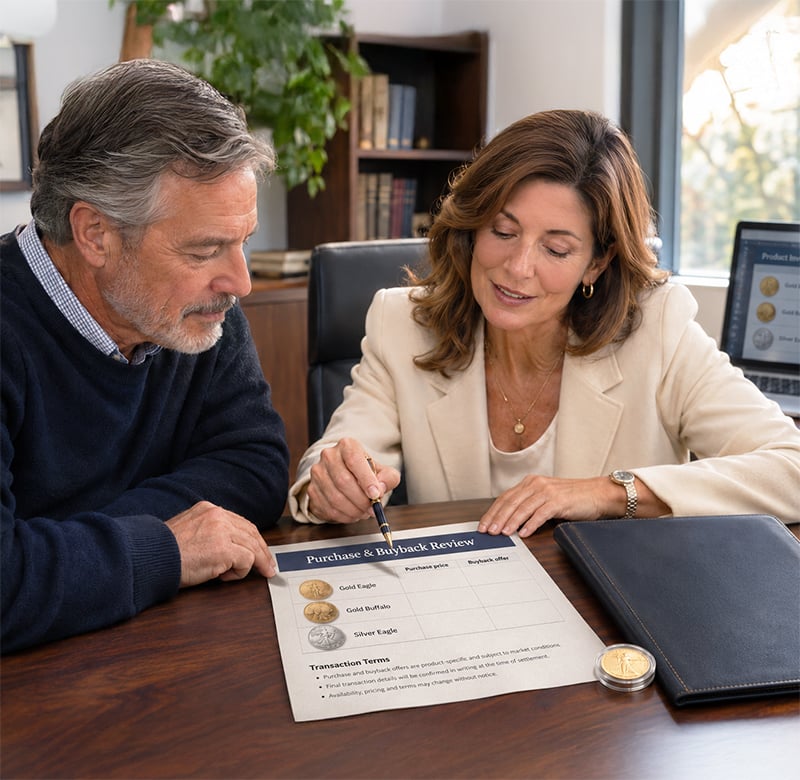
At Augusta, we want customers to understand both sides before deciding. Our educational process helps retirement savers understand the risks, costs, and mechanics of precious metals ownership. Later, when they’re considering specific products, our Order Desk reviews purchase prices, corresponding same-day buyback values, and transaction terms.
We’re not trying to make the investment decision as fast as possible. We want customers to understand what they’re buying, what they’re paying, and what could happen when they eventually need to sell.

What Is Augusta Precious Metals’
Actual Buyback Spread?
Augusta Precious Metals targets a 5% purchase-to-buyback spread for qualifying structured transactions, in accordance with the terms of the Augusta Transaction Agreement. Our Pricing, Spreads, and Resale FAQs describe eligible partial IRA sales, required minimum distributions, and qualifying non-IRA partial sales of metals held at least five years. Immediate complete liquidations are priced differently.
Augusta also focuses on serving retirement customers through an established Dealer Network, designed to support ongoing service and competitive, product-specific buyback offers.
What Is Augusta Precious Metals’
Actual Buyback Spread?
Augusta Precious Metals targets a 5% purchase-to-buyback spread for qualifying structured transactions, in accordance with the terms of the Augusta Transaction Agreement. Our Pricing, Spreads, and Resale FAQs describe eligible partial IRA sales, required minimum distributions, and qualifying non-IRA partial sales of metals held at least five years. Immediate complete liquidations are priced differently.
Augusta also focuses on serving retirement customers through an established Dealer Network, designed to support ongoing service and competitive, product-specific buyback offers.
Choosing a Gold Dealer:
What Else Should You Ask?
The buyback price matters. But there are a few other questions you should ask before choosing a dealer.
What About Free Silver?
If a dealer offers you free silver, ask what you’re paying for the whole order and what they would pay to buy all of it back—including the “free” silver.
You still need both numbers.
The offer may sound good. But you can’t tell how good it is until you understand the whole transaction.
What Other Costs Will You Pay?
What will the custodian charge? What will storage cost? Are there charges when you sell?
Ask about those costs before you buy, too. They’re separate from the spread, but they still affect what you pay to own the metals.
How Does the Person Helping You Get Paid?
Does their compensation change depending on which products you buy?
It’s a fair question. You want to understand whether the person helping you has a financial incentive to recommend one product over another.
Understand Both Prices Before You Buy
The important thing is that customers understand the actual economics of the metals they are considering.
Get the education. Understand the spread. Ask about buybacks. And learn how distributions work before committing retirement savings.
Because when you’re investing for retirement, what happens when you sell matters just as much as what happens when you buy.
Learn more in Augusta’s one-on-one educational web conference.

Opinions offered by Augusta Precious Metals are its own. Additionally, while Augusta attempts to provide factually accurate information, information presented by Augusta may turn out to be inaccurate or incomplete. You should conduct your own independent verification of any facts or opinions presented prior to making any investment.
All decisions regarding the purchase or sale of precious metals are your own, and should only be made after considering your investment objectives, risk tolerance, and level of experience. Augusta Precious Metals cannot guarantee, assure, or promise future market movement, prices, or profits. Past performance does not guarantee future results. Any investment in precious metals is speculative and could result in significant financial losses.