


Precious Metals 101: A Beginner's Guide to Investing for Retirement
Retirement planning has felt less predictable lately. Silver spiked to roughly $121 an ounce in January 2026 before pulling back sharply, the US-Iran conflict in February rattled safe-haven markets, and a hawkish Fed pivot mid-year shifted rate expectations almost overnight. It's the kind of stretch that gets retirement savers asking: does it make sense to hold something outside paper assets?
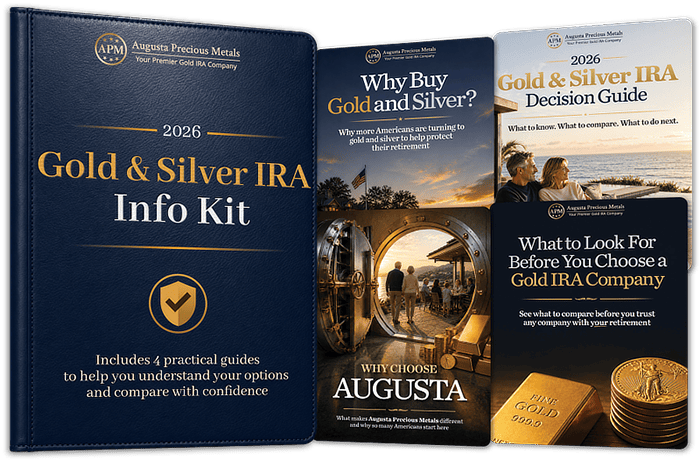
That's why many explore adding physical gold and silver as long-term "ballast" alongside stocks, bonds, and cash — metals carry no counterparty risk and can help diversify portfolios otherwise tied to paper-based assets. This Info Kit walks through how metals may realistically fit into a retirement plan, what to expect, and what beginners tend to get wrong.
Get Your Free
Gold & Silver IRA
Info Kit

What Precious Metals Do
(and Don't Do)
- Diversification — gold and silver historically have moved differently than equities and some bonds.
- Inflation hedge — not a perfect one, but metals have historically often helped preserve purchasing power.
- Crisis insurance — the value of physical assets held in an IRS-compliant depository isn’t dependent on a bank’s or company’s solvency.
They’re also not income-producing, can swing sharply short-term, and work best as a modest, long-term allocation — not as a trading strategy, and not the whole plan.
Getting Started: The Roadmap
Most beginners aren’t short on interest in precious metals — they’re short on knowing what order things happen in:
- Decide if metals fit your plan. Weigh the diversification case above against your own timeline and goals.
- Choose how to hold them. Direct purchase, or, more commonly for retirement savers, a self-directed IRA for the tax advantages.
- Open the account with a qualified custodian. See why you need one.
- Fund it. Usually done via a direct rollover from a 401(k), 403(b), TSP, or existing IRA.
- Select IRA-eligible metals. Not every coin or bar qualifies.
- Arrange IRS-compliant storage. Metals ship to an insured depository, not your home.

Gold, silver, platinum, and palladium each play a different role — gold for stability, silver for affordability with more industrial-driven volatility, platinum and palladium for a more specialized allocation. Expect custodial, storage, and insurance fees plus an amount over spot; Augusta is transparent about all of it up front. For the fuller case on physical ownership, see why investors buy physical gold to diversify.

Building a Sensible Allocation
Financial professionals commonly cite roughly 5% to 10% of a diversified portfolio as a starting point — though the right number depends on your goals, timeline, and risk tolerance. As Devlyn Steele, Augusta’s director of education, puts it, the real question isn’t whether to own only gold — it’s how much of your retirement savings do you want to exist outside paper-based assets if inflation or instability continue long term. Augusta’s educators can walk through historical scenarios and provide information to help you craft an allocation that complements, rather than replaces, a broader plan — alongside your own tax and financial professional.
Common Mistakes Beginners Make

Going too big, too fast. Regret usually comes from moving a large share of savings into precious metals all at once — often after a single ad or podcast — without weighing concentration risk first.

Underestimating the spread. The gap between what you pay and what you’d get back the same day matters more than how close a price sits to spot.

Assuming every company works the same way. The industry ranges from fast, commission-driven sales to education-first companies — that difference in structure, not the industry as a whole, determines the experience.

Skipping the “what if I want to sell” question. Ask before buying, not after.
Learn the Process in a 1-on-1 Web Conference
Success with precious metals comes down to clear goals, the right IRA structure, transparent costs, and a disciplined allocation. Reserve a spot with Augusta for a free web conference to see how a self-directed IRA works, what qualifies, and how to avoid the mistakes above — you’ll leave with practical checklists and the beginnings of a clearer path forward.
Frequently asked questions
Beyond price, what should I actually compare between gold IRA companies?
Company structure and incentives matter more than headline pricing — whether educators are salaried or work on commission, whether there’s a clear buyback guarantee, and whether reviews are verified across independent platforms like the BBB and Trustpilot rather than only the company’s own site. Augusta’s educators are salaried with no commission specifically so that incentive structure doesn’t work against you.
Should I buy all at once, or spread purchases out over time?
Many investors phase in a precious metals allocation over several purchases rather than a single lump sum — partly because prices can move meaningfully in a short window, and partly because it mirrors how they’d approach any other new position in a portfolio. There’s no single right cadence; it depends on your timeline and how the rest of your portfolio is positioned, which is exactly the kind of question Augusta’s educators walk through directly, so you can discuss with your advisors.
Does the 5% to 10% allocation guideline change the closer I get to retirement?
Not automatically, but the reasoning behind it shifts. Earlier in a career, a metals allocation is mostly about long-term diversification. Closer to retirement, the same allocation also has to account for how and when you’d actually convert some of it to income or take distributions. That’s a different lens on the same number, not a reason to abandon it.
Isn't a gold ETF simpler than a physical precious metals IRA?
In some ways. An ETF trades like a stock with no storage or depository involved. But it’s a paper-based claim on a fund, not direct ownership of metal, and it depends on custodians, exchanges, and fund managers functioning normally. A self-directed precious metals IRA is the structurally different path for investors specifically seeking direct, tangible ownership. See gold ETFs explained for the full comparison.
Why does Augusta slow the buying process down instead of moving quickly?
Augusta intentionally slows the process down and requires a dedicated educational conference before any purchase — even after an account is already funded — because the goal is understanding, not urgency.
What happens to my precious metals IRA when I retire and want to take distributions?
Traditional IRAs are subject to required minimum distributions (RMDs) once the applicable age is reached. Distributions can generally be taken in cash, by selling the metal, or in kind, by taking physical delivery. The right approach depends on individual circumstances, so this is a good one to work through directly with a tax advisor as retirement approaches.
Augusta Precious Metals works with retirement savers who are prepared to invest at least $50,000 from an existing IRA, 401(k), TSP, or similar retirement account.

Opinions offered by Augusta Precious Metals are its own. Additionally, while Augusta attempts to provide factually accurate information, information presented by Augusta may turn out to be inaccurate or incomplete. You should conduct your own independent verification of any facts or opinions presented prior to making any investment.
All decisions regarding the purchase or sale of precious metals are your own, and should only be made after considering your investment objectives, risk tolerance, and level of experience. Augusta Precious Metals cannot guarantee, assure, or promise future market movement, prices, or profits. Past performance does not guarantee future results. Any investment in precious metals is speculative and could result in significant financial losses.